Updated . Built step by step in a real Runable Free-plan account on 19 October 2026. Every screen in the practice is a real Runable screen, and every output is what Runable produced in that run. How we check this lesson
Research tells you the market is there. A plan tells you what to do next. In this free lesson you turn Harbor & Pine's research into a one-page launch plan with Runable's Report tool and its Business Plan template. Runable tags every line as a research fact or an assumption. Then you catch the one number that does not add up, a materials cost of $9 a candle against a $1,000 budget for 60 to 80 candles, and get it fixed with the math shown. The whole plan used 14 credits.
At a glance
| Question | Answer |
|---|---|
| What you build | A business case for new founders: turn your research into a one-page launch plan with Runable's Report tool and Business Plan template, read the fact and assumption tags, catch a cost-per-unit that does not match the budget, and get it fixed with the math shown. Free plan. |
| Tools | Runable |
| Time | About 10 minutes, 19 steps in 5 parts |
| Level | Beginner, no coding needed |
| Cost | Free |
| Ways to learn it | Practice it step by step, read the guide with screenshots |
The 5 parts, in short
- A plan, not just research: See what one wrong number costs, Use the Business Plan template, Gather your facts first.
- Start from the Business Plan template: Open Report, Pick Business Plan, Use a template, Swap in your facts, and 1 more step.
- Read the plan like a lender would: Open the plan, Learn the tags, Find the number that does not add up.
- Fix the number that does not add up: Ask for the fix, with the math, Send the fix, Check the new math, Open the export options, and 2 more steps.
- What it saved, and what is next: See what you have now, Up next.
Start here first: Size Up Your Market and 5 Competitors Before You Spend a Dollar using Runable (module 1 of Runable for Entrepreneurs)
Part of: AI Apps Worth Knowing (step 13 of 186). Next up: Make an Instagram Launch Carousel for Your Products using Runable
How to turn Your Research into a One-Page Business Plan using Runable: step-by-step guide with screenshots
About the screenshots. They come from Stepthrough’s simulated practice environment (a practice copy of Runable), not the live tool, so no real account appears. The buttons and labels match the real screens the lesson was built against. Practice it yourself free at ynteractive.com.
- Tools: Runable
- Time: about 10 minutes, 19 steps in 5 parts
- Level: beginner, no coding needed
Part 1: A plan, not just research
Step 1: See what one wrong number costs
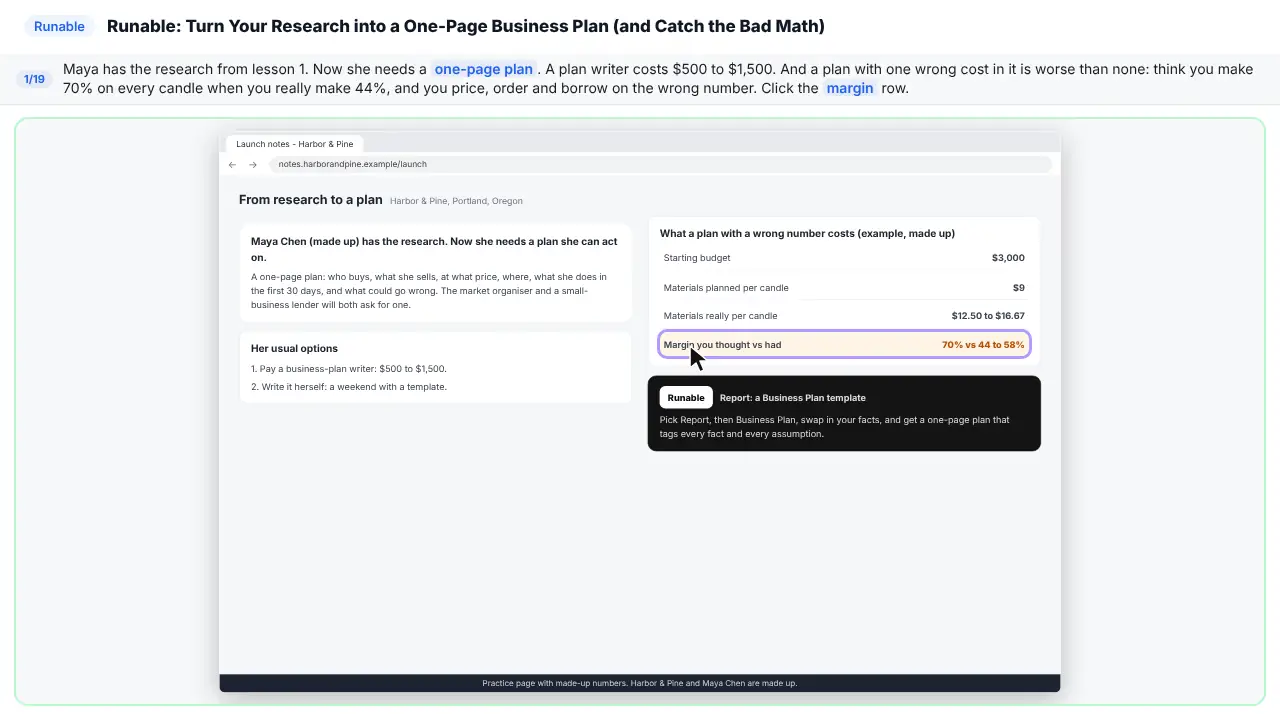
Maya has her research. Now she needs a one-page plan. A plan with one wrong number is worse than no plan.
Step 2: Use the Business Plan template
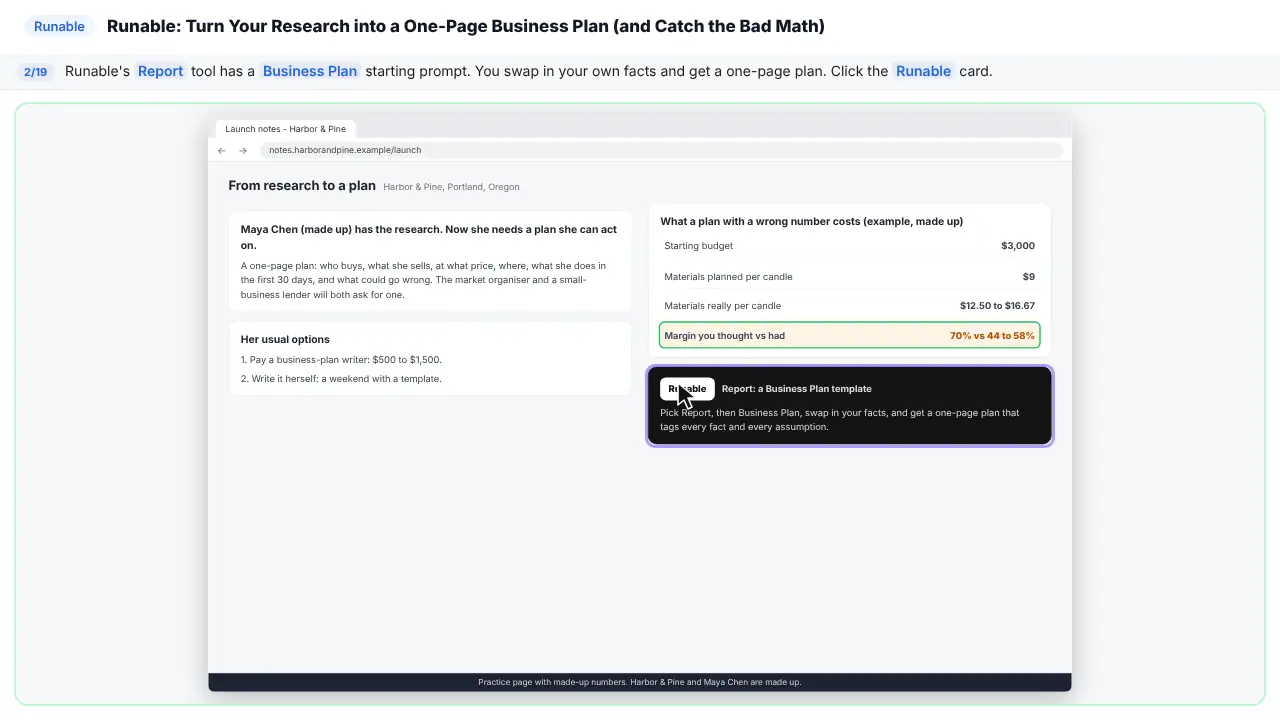
Runable has a Business Plan template. You swap in your own facts.
Step 3: Gather your facts first
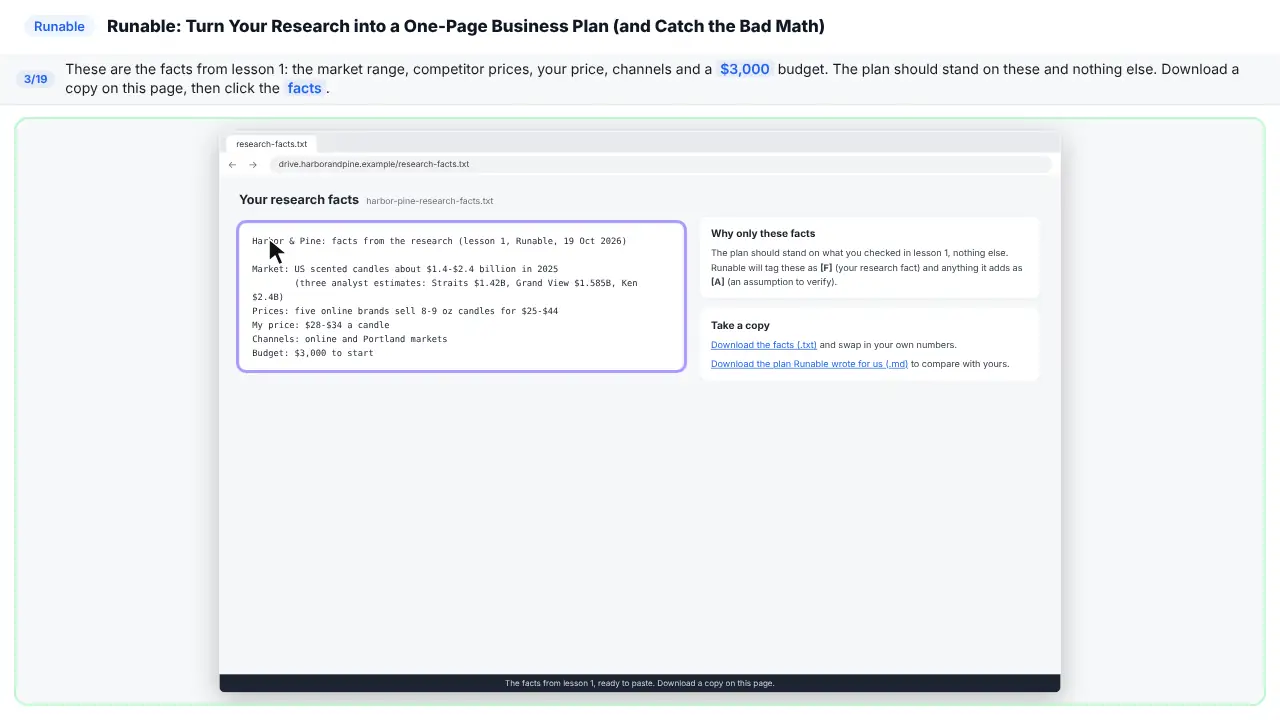
These are the facts from your research. The plan should stand on these, and nothing else.
Part 2: Start from the Business Plan template
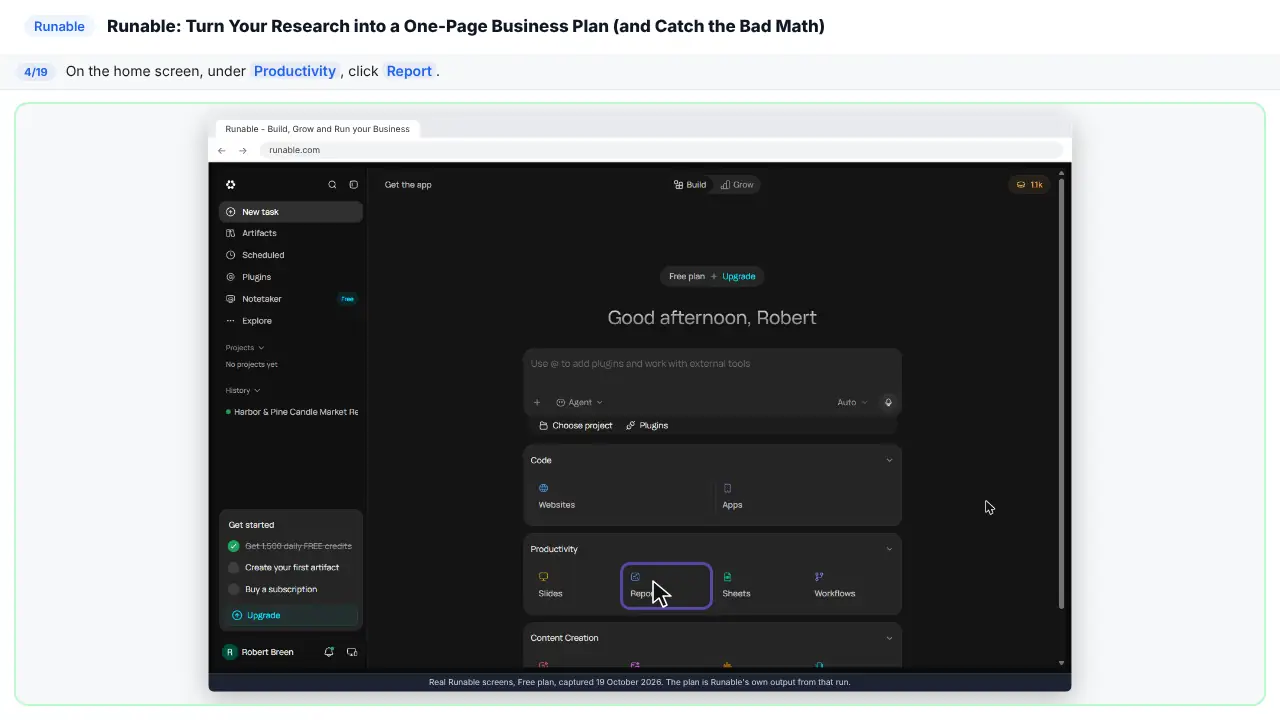
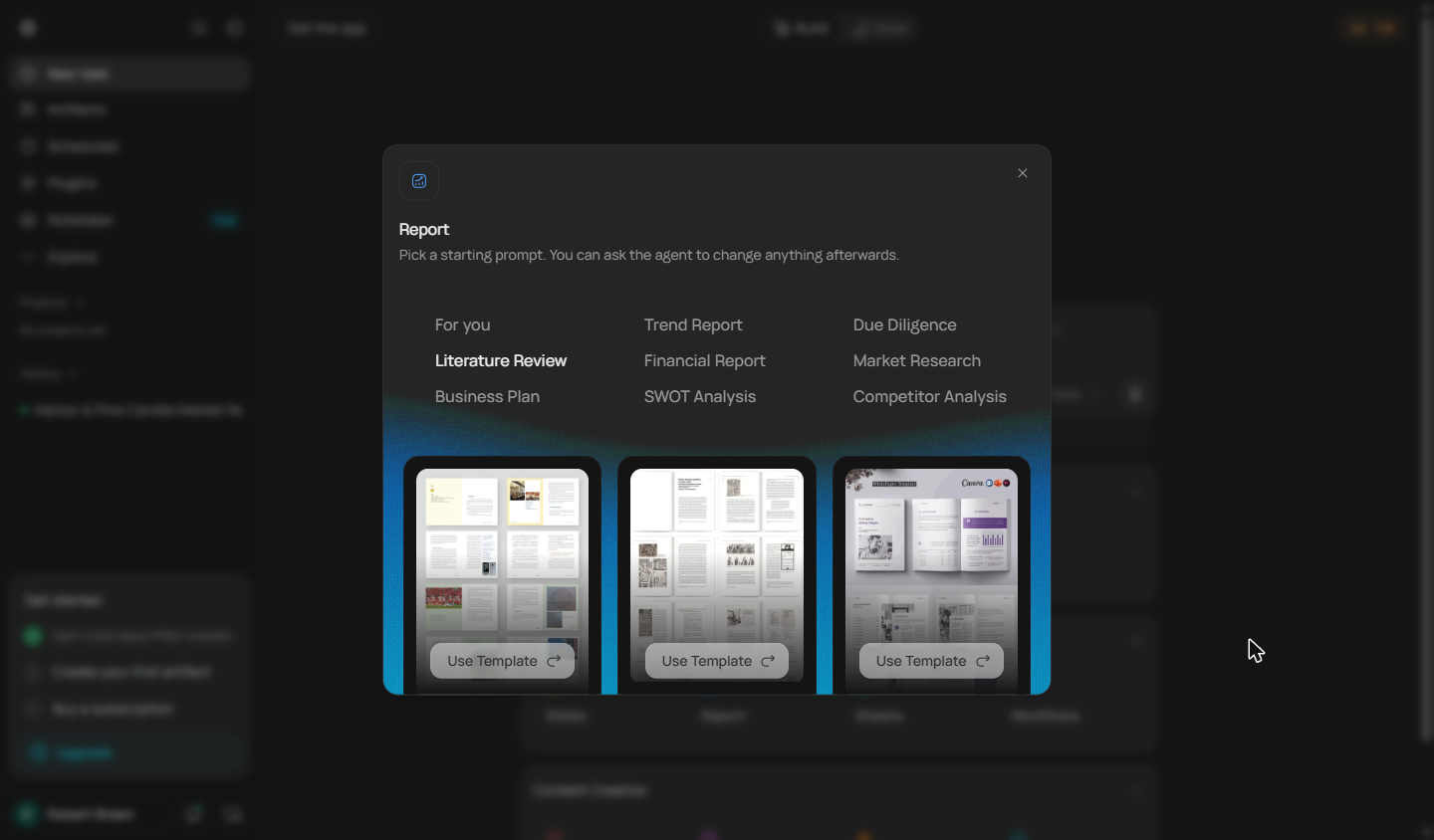
Step 4: Open Report
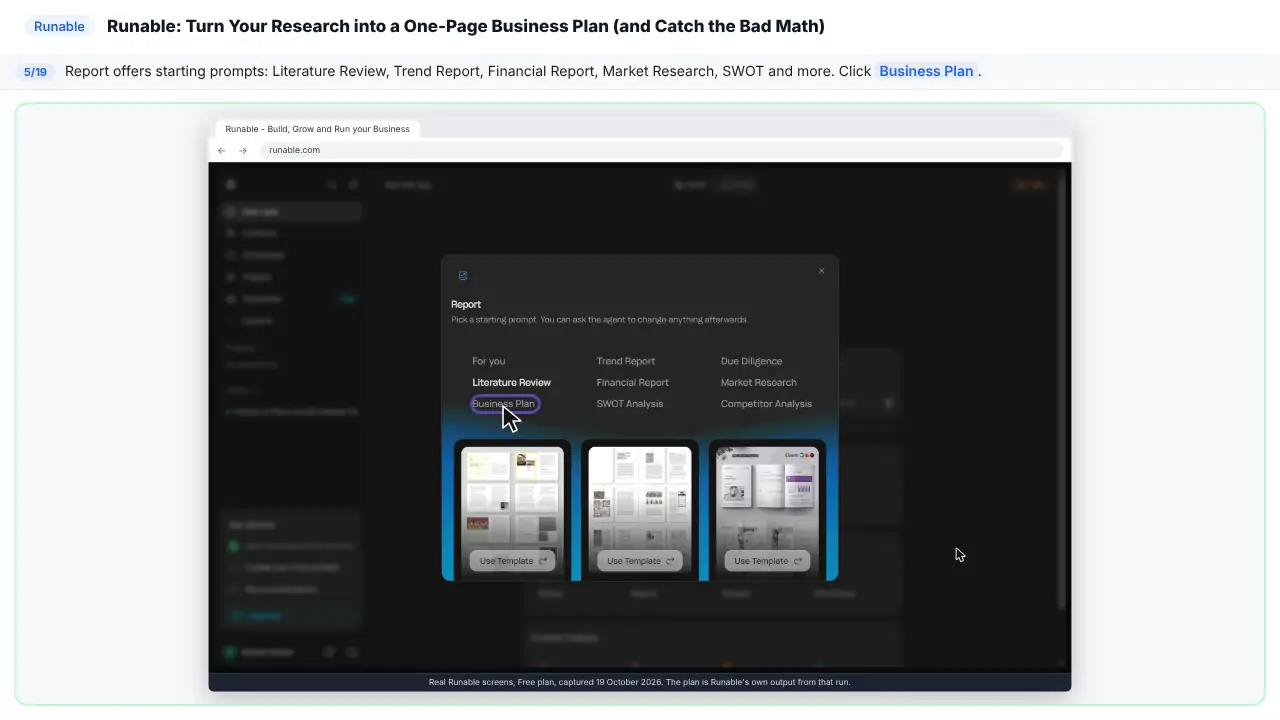
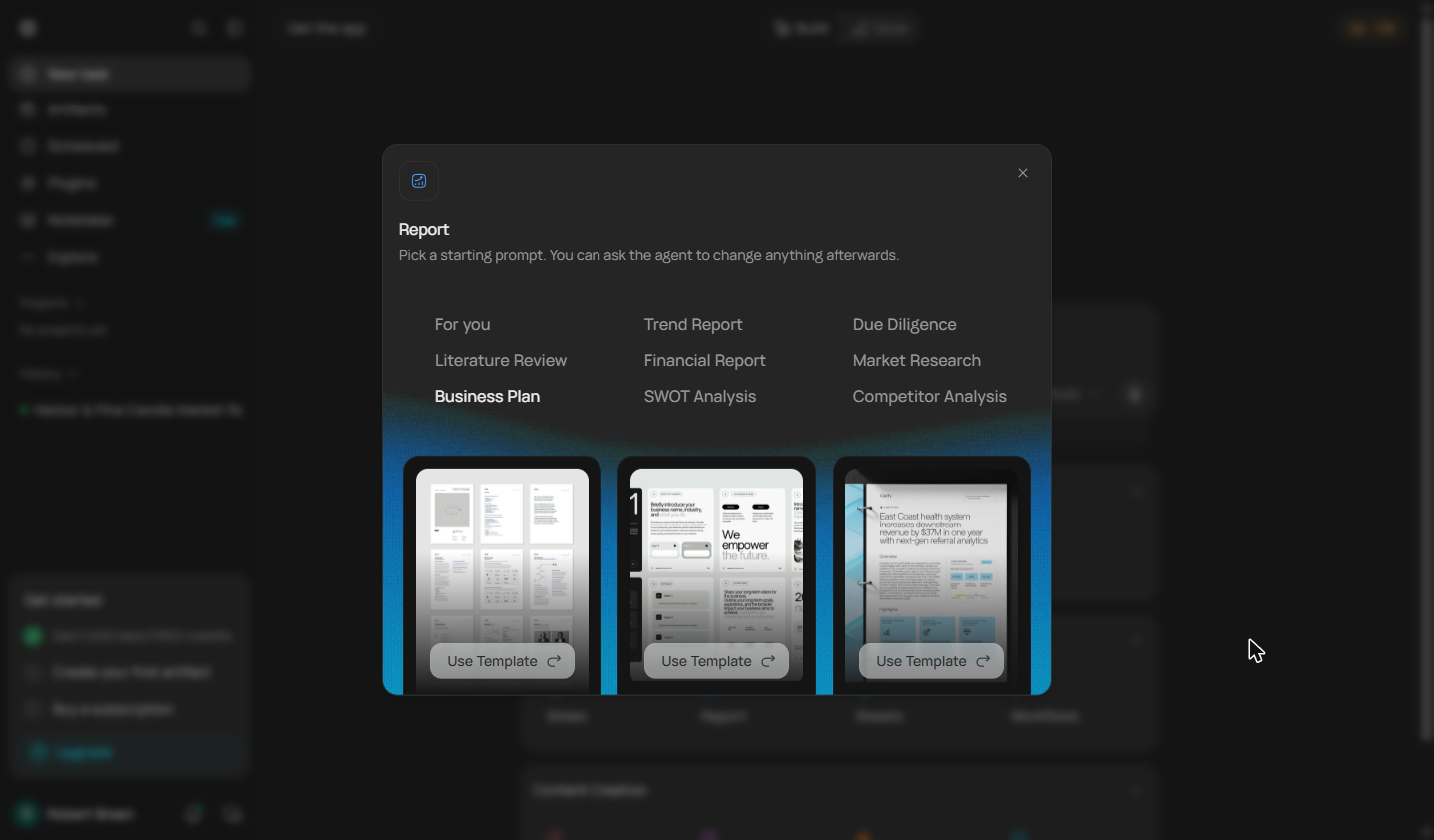
Step 5: Pick Business Plan
Pick a starting prompt.
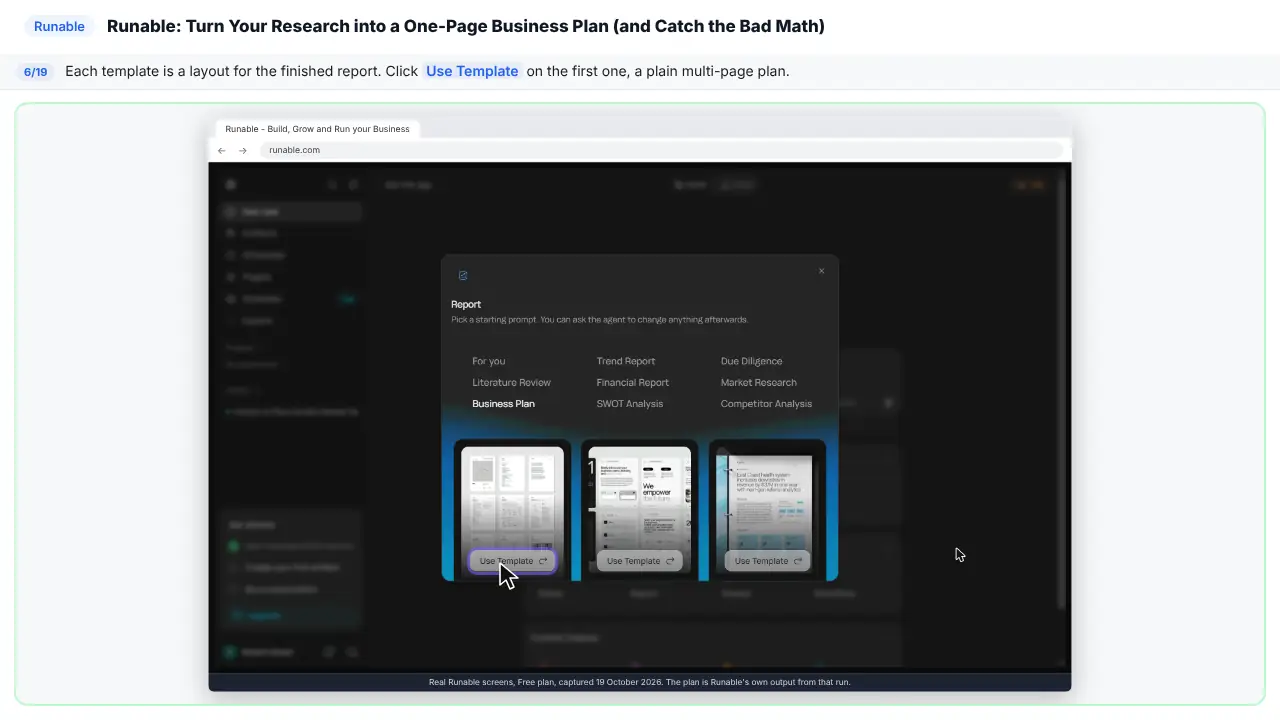
Step 6: Use a template
Each template is a layout.
Step 7: Swap in your facts
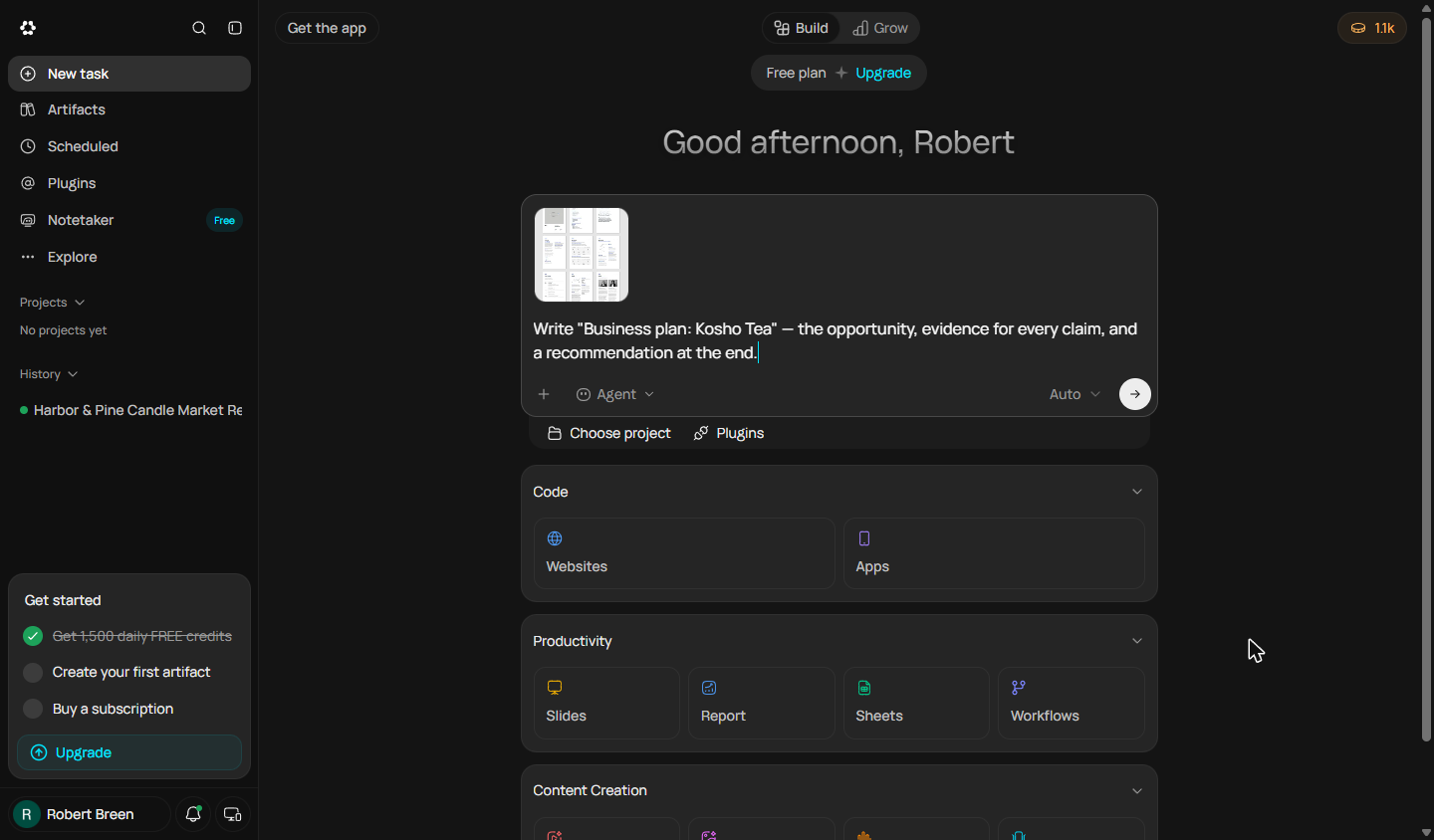
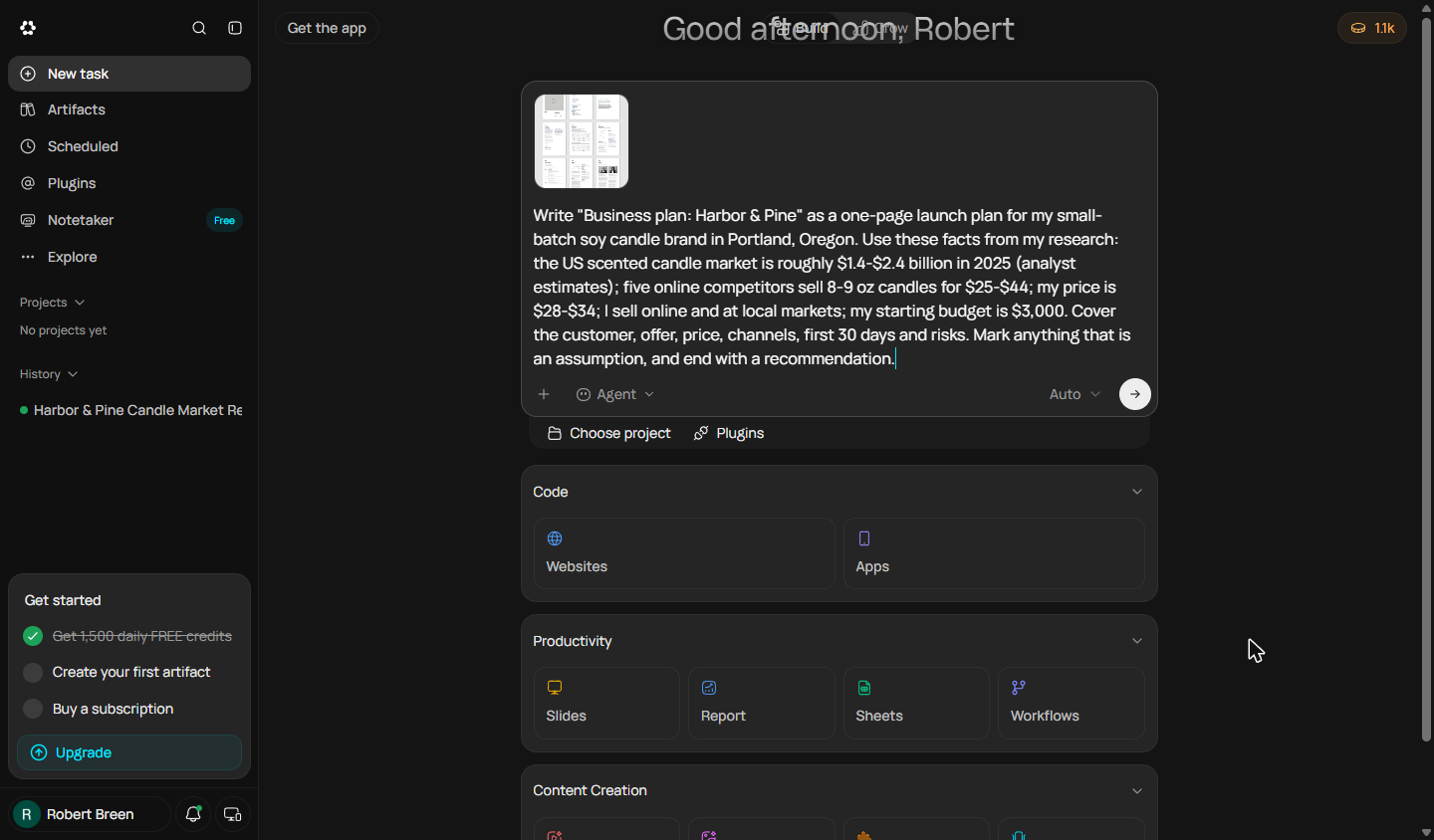
The template comes with a sample prompt about a tea brand. Replace it with yours. Ask it to mark every assumption.
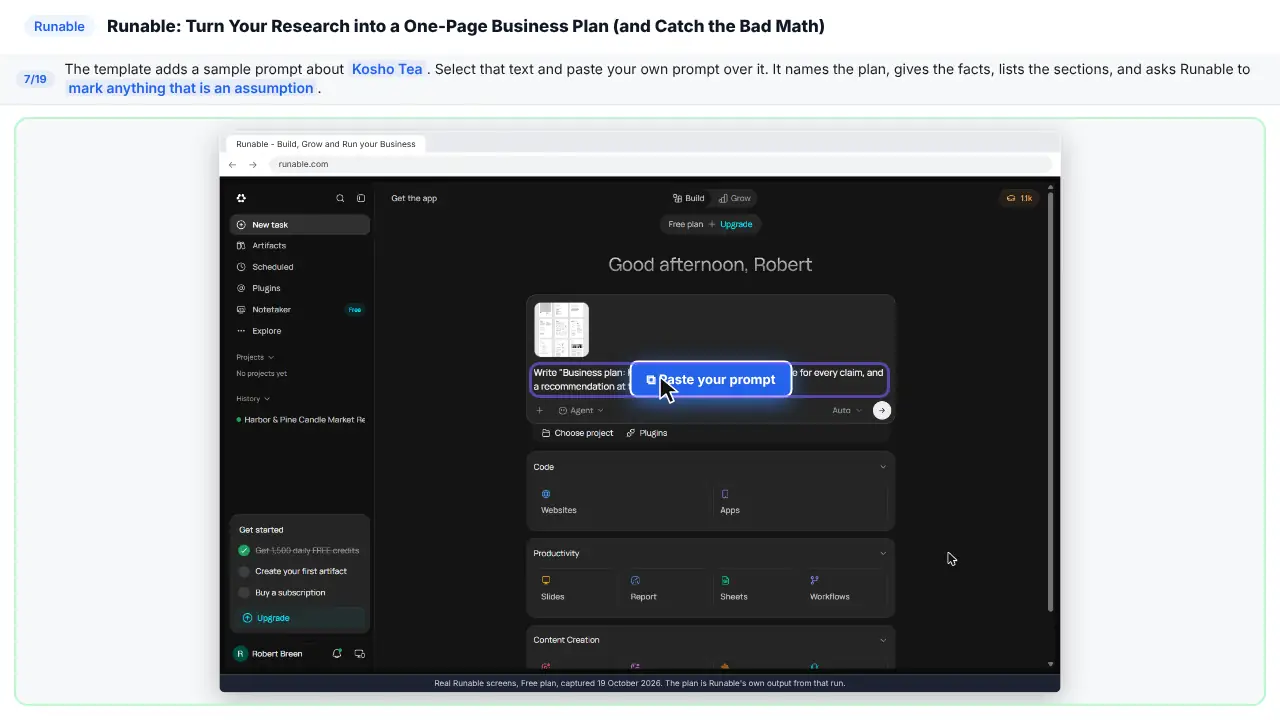
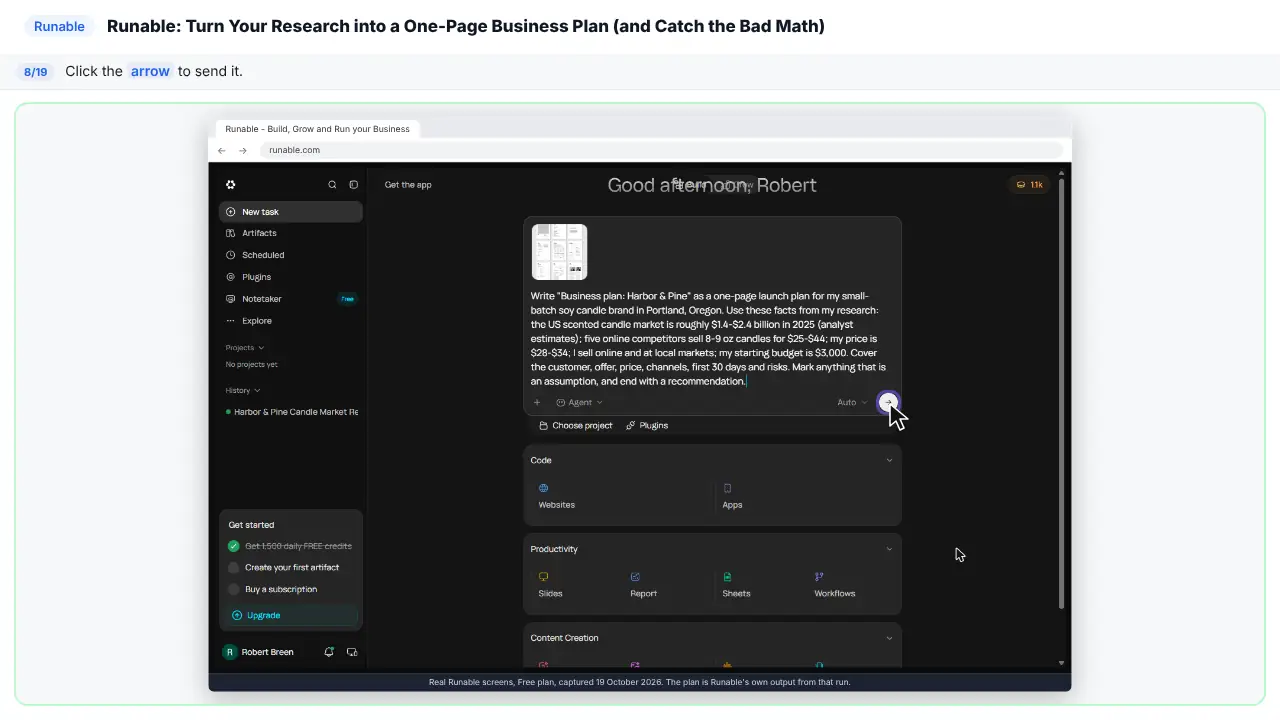
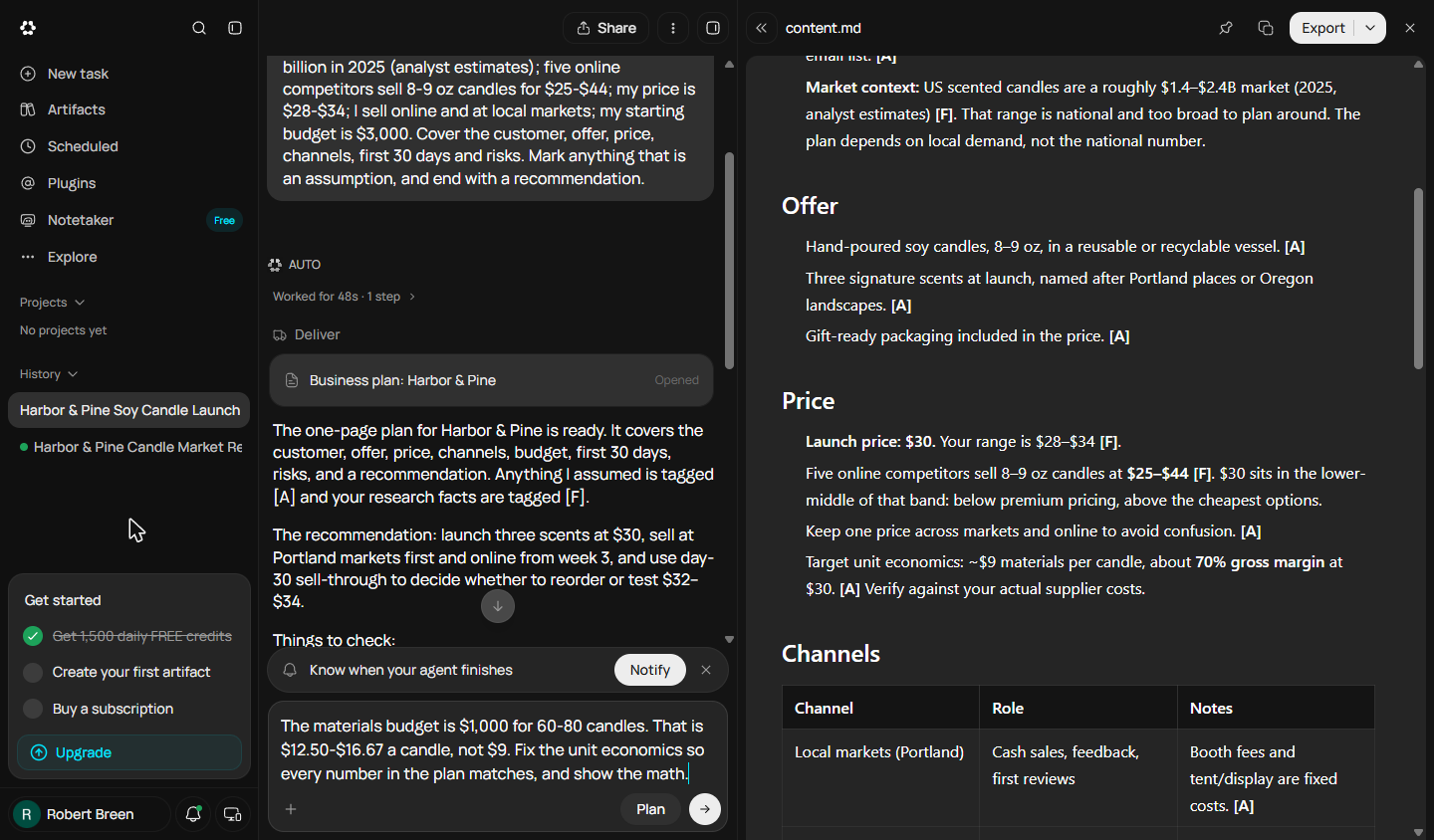
Write "Business plan: Harbor & Pine" as a one-page launch plan for my small-batch soy candle brand in Portland, Oregon. Use these facts from my research: the US scented candle market is roughly $1.4-$2.4 billion in 2025 (analyst estimates); five online competitors sell 8-9 oz candles for $25-$44; my price is $28-$34; I sell online and at local markets; my starting budget is $3,000. Cover the customer, offer, price, channels, first 30 days and risks. Mark anything that is an assumption, and end with a recommendation.
Step 8: Send it
Part 3: Read the plan like a lender would
Step 9: Open the plan
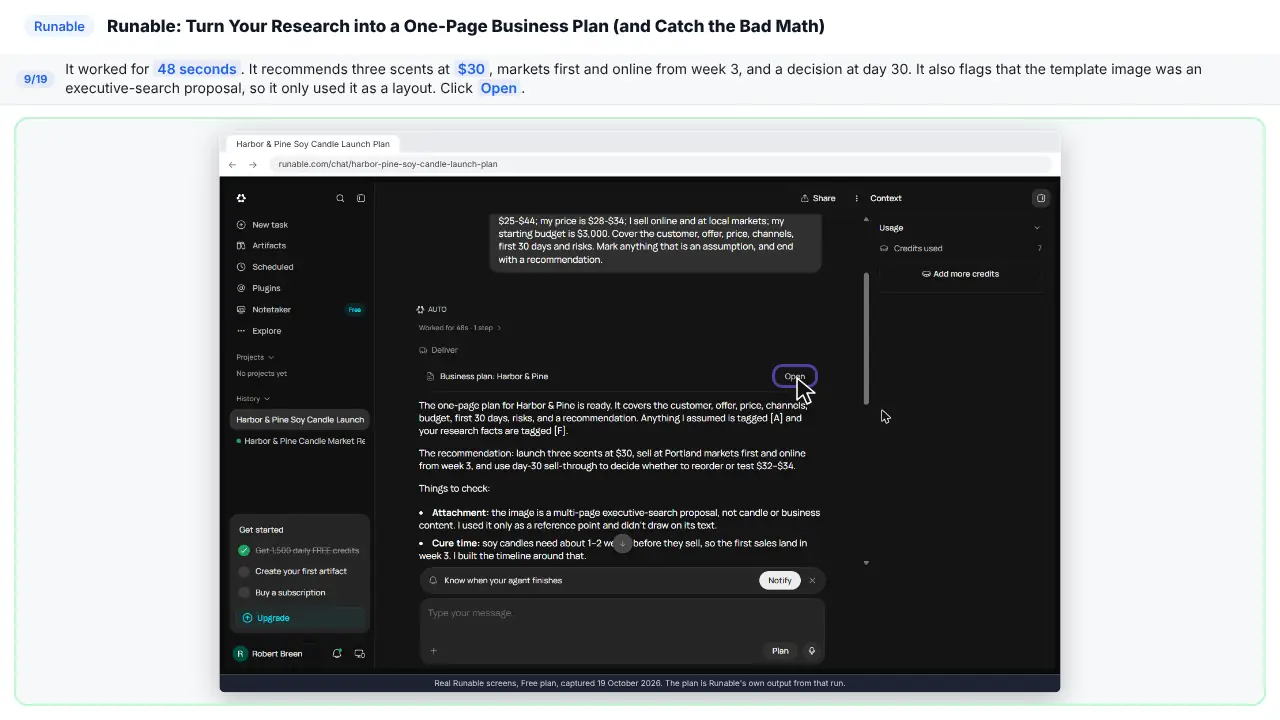
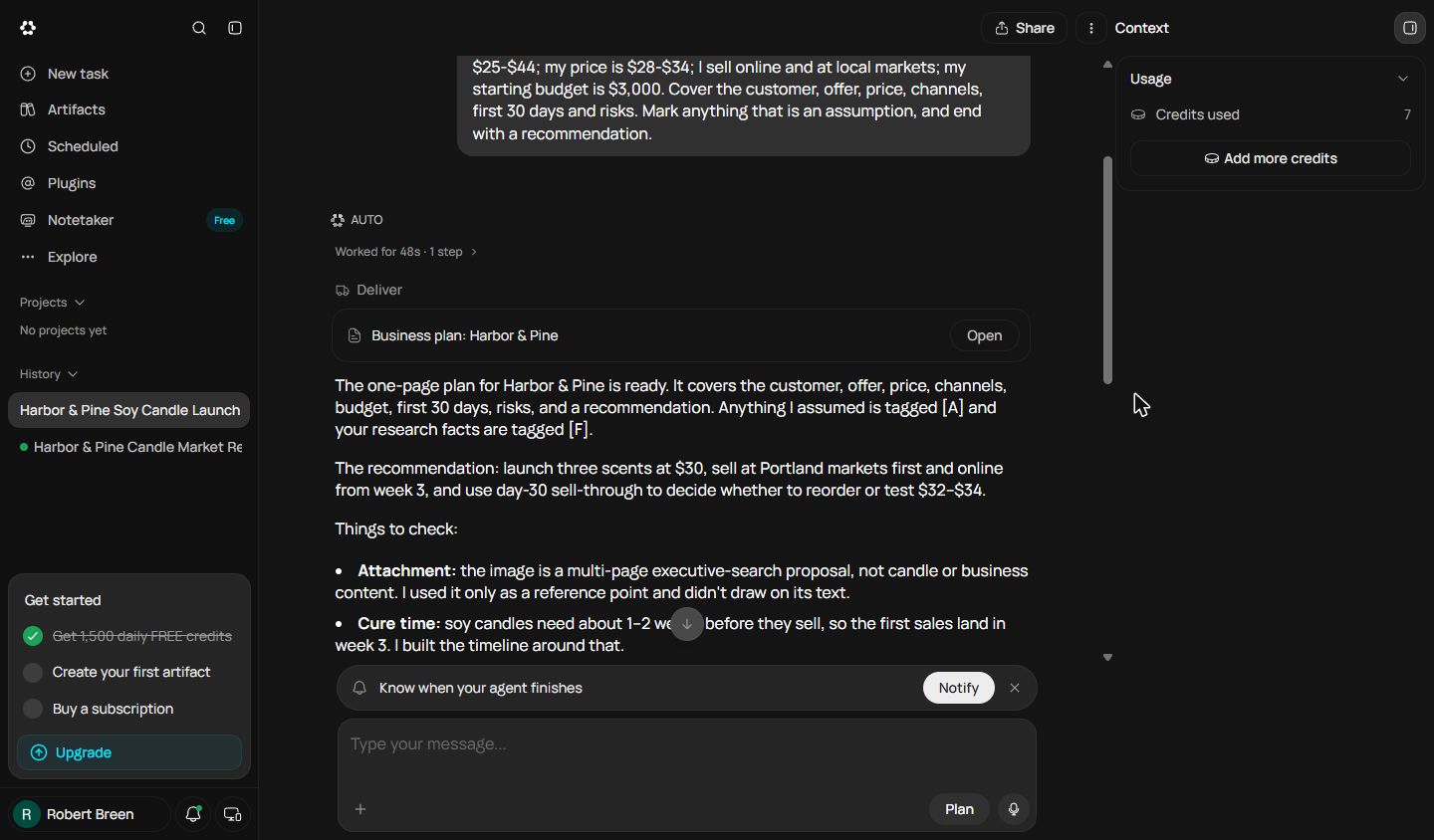
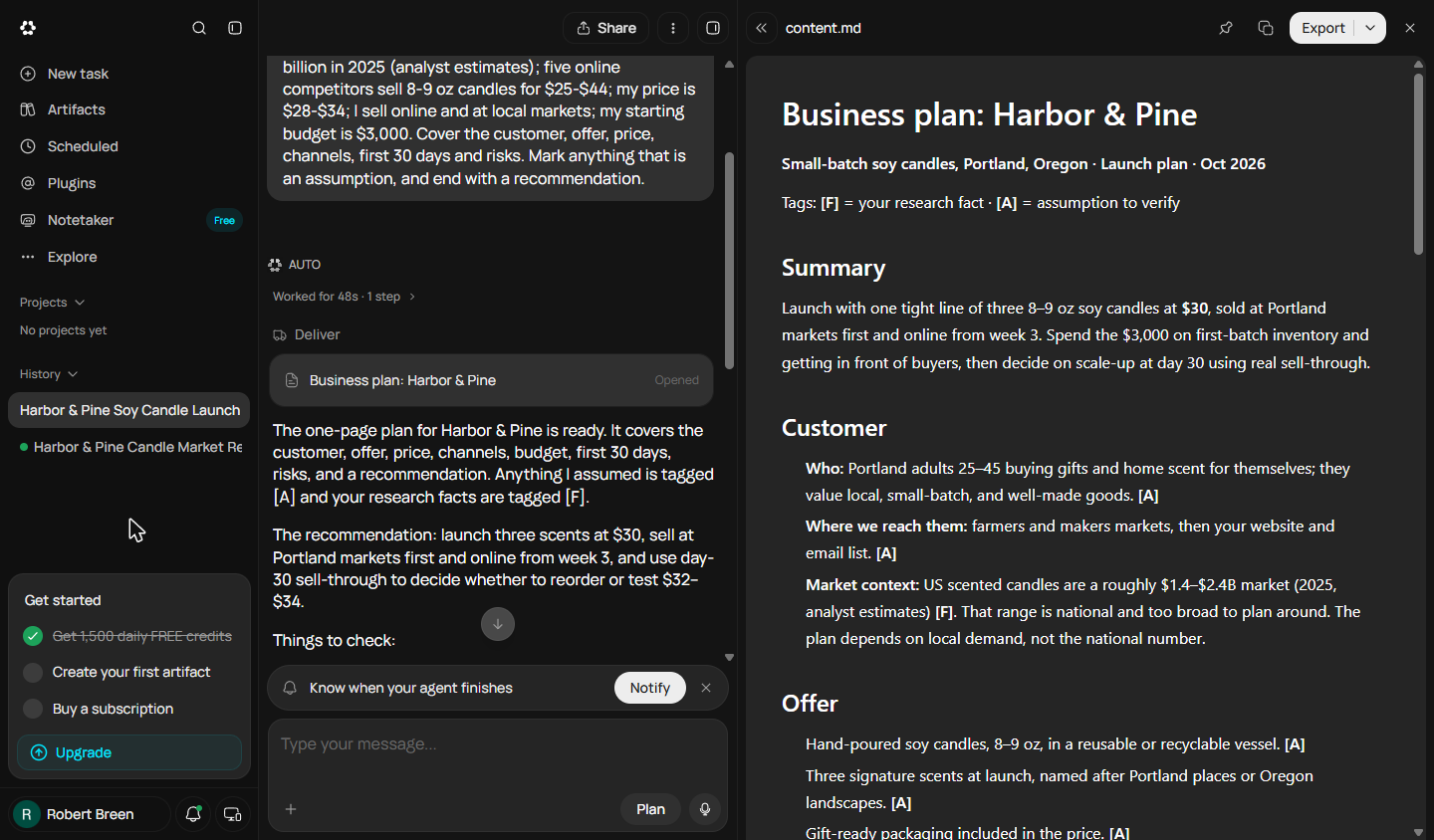
It took under a minute. Three scents, thirty dollars, markets first.
Step 10: Learn the tags
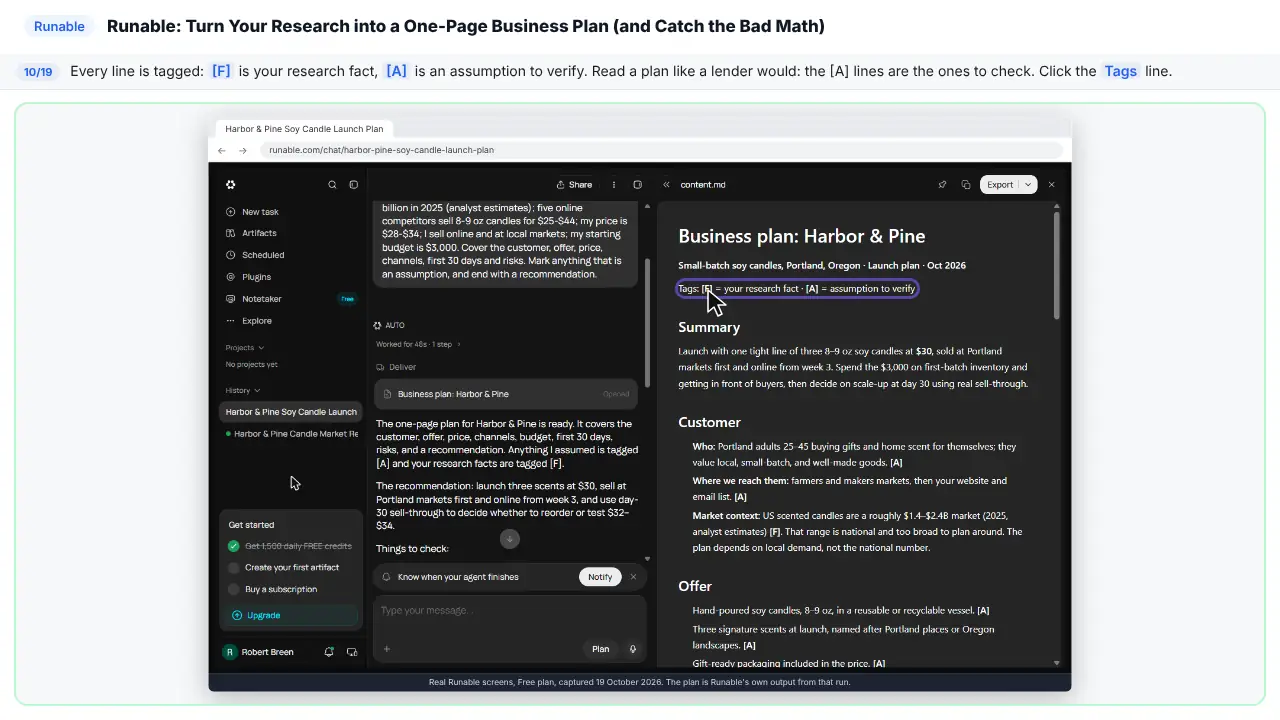
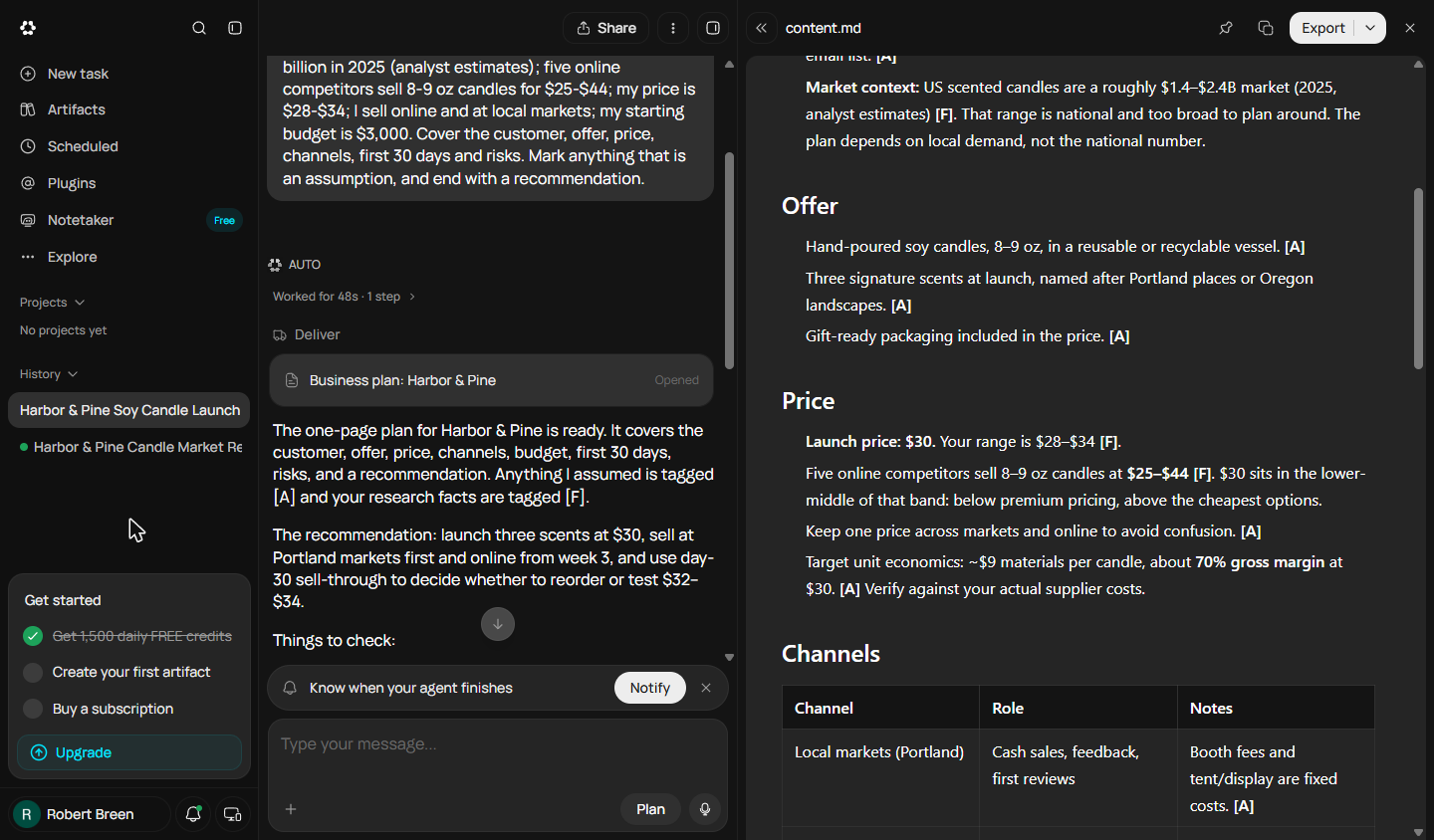
Every line is tagged. F is a fact from your research. A is an assumption. The A lines are the ones to check.
Step 11: Find the number that does not add up
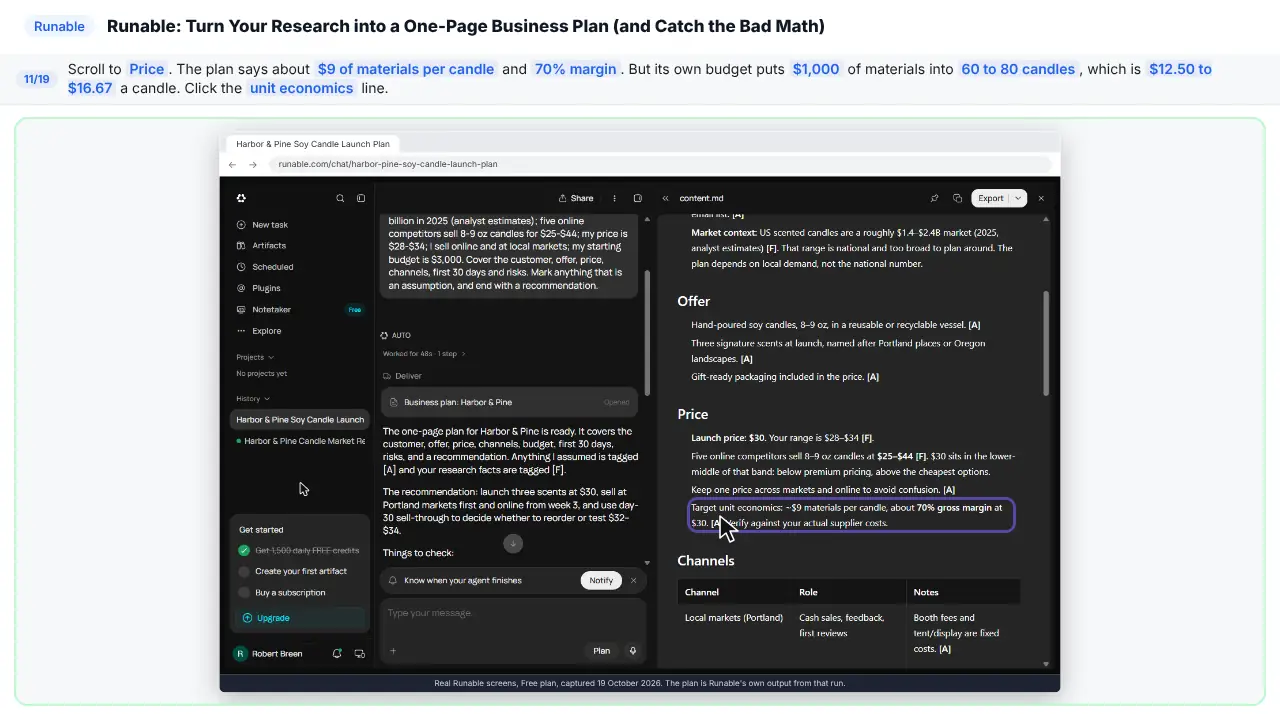
Look at the price section. It says nine dollars of materials a candle. But its own budget says a thousand dollars for sixty to eighty candles. That's twelve fifty to sixteen sixty-seven. The numbers don't match.
Part 4: Fix the number that does not add up
Step 12: Ask for the fix, with the math
Tell it what's wrong. And ask it to show the math.
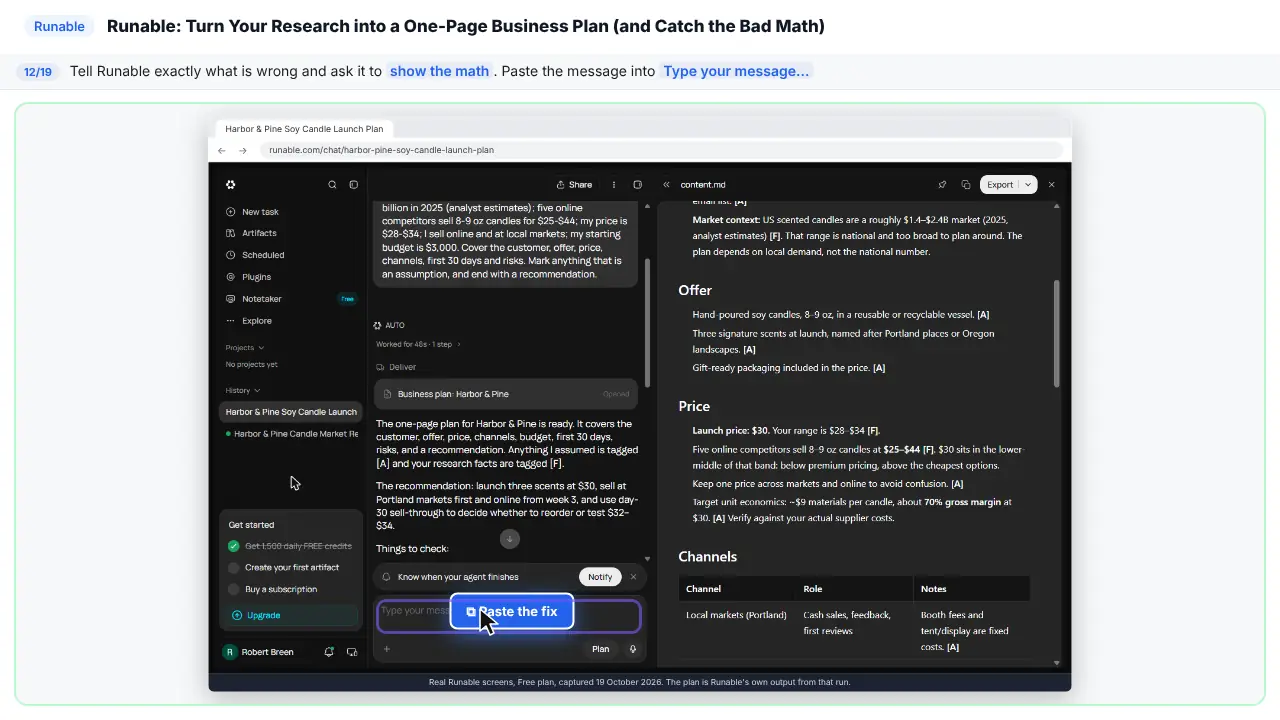
The materials budget is $1,000 for 60-80 candles. That is $12.50-$16.67 a candle, not $9. Fix the unit economics so every number in the plan matches, and show the math.
Step 13: Send the fix
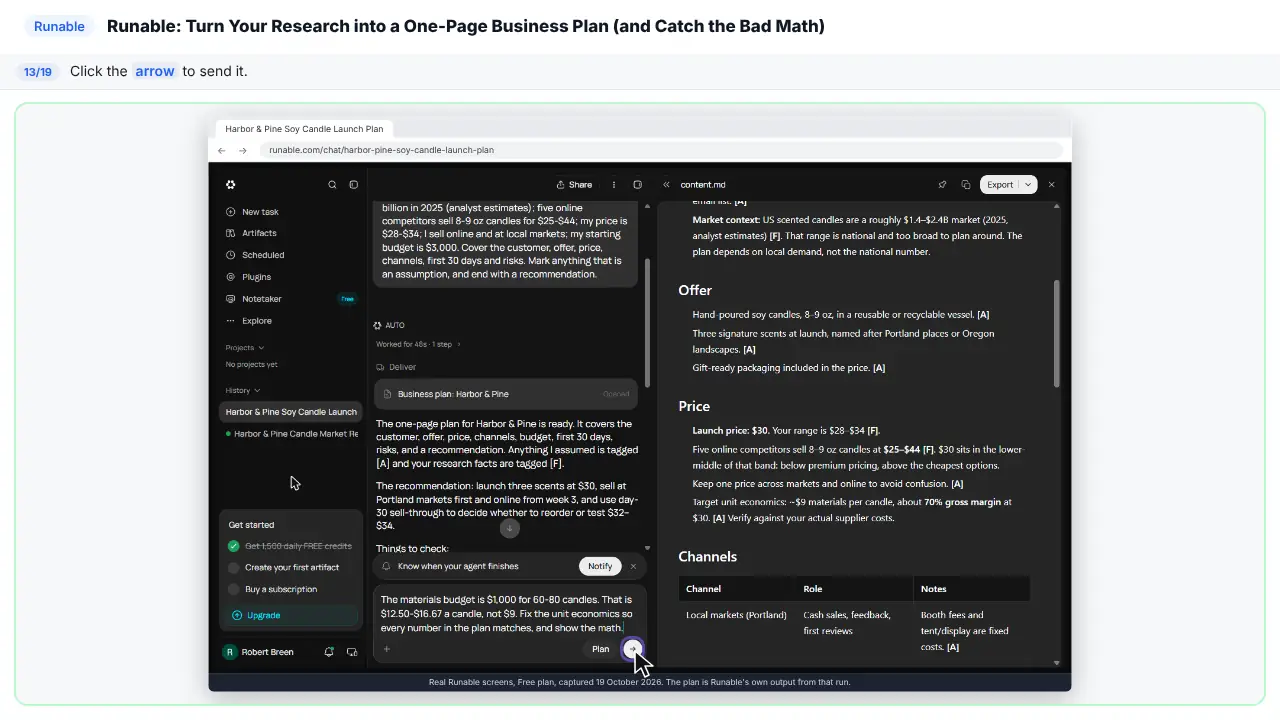
Step 14: Check the new math
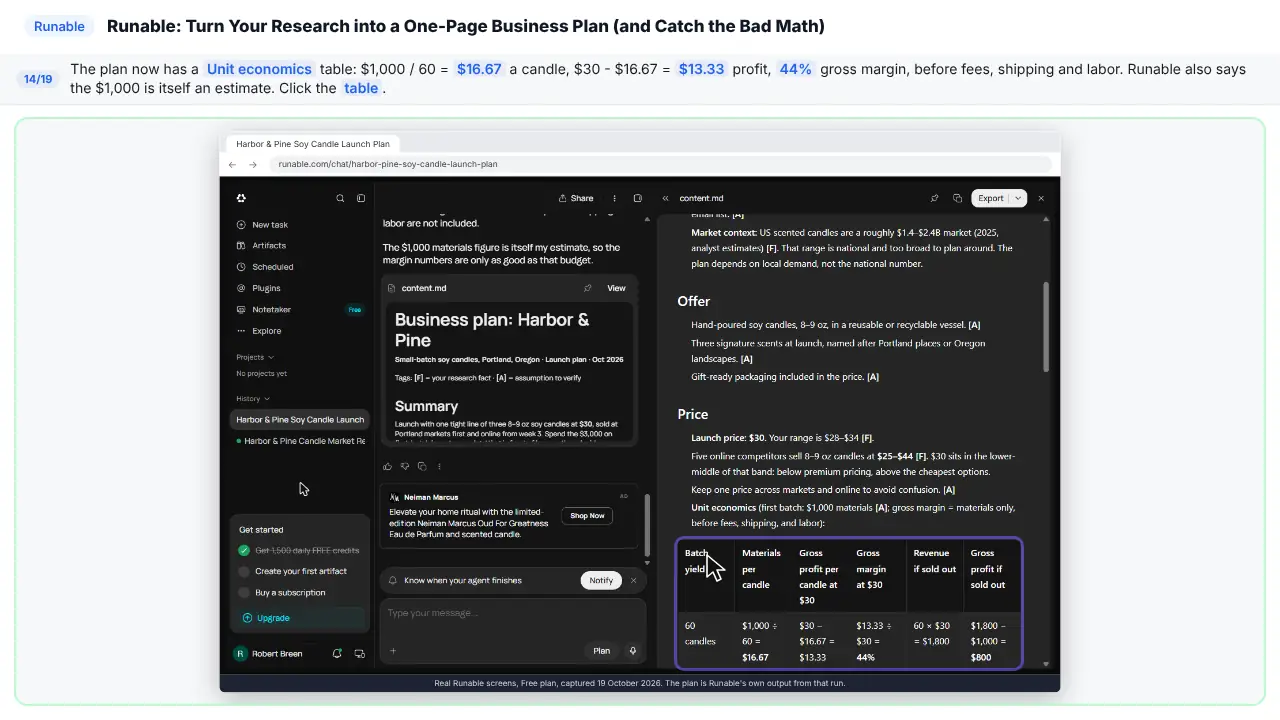
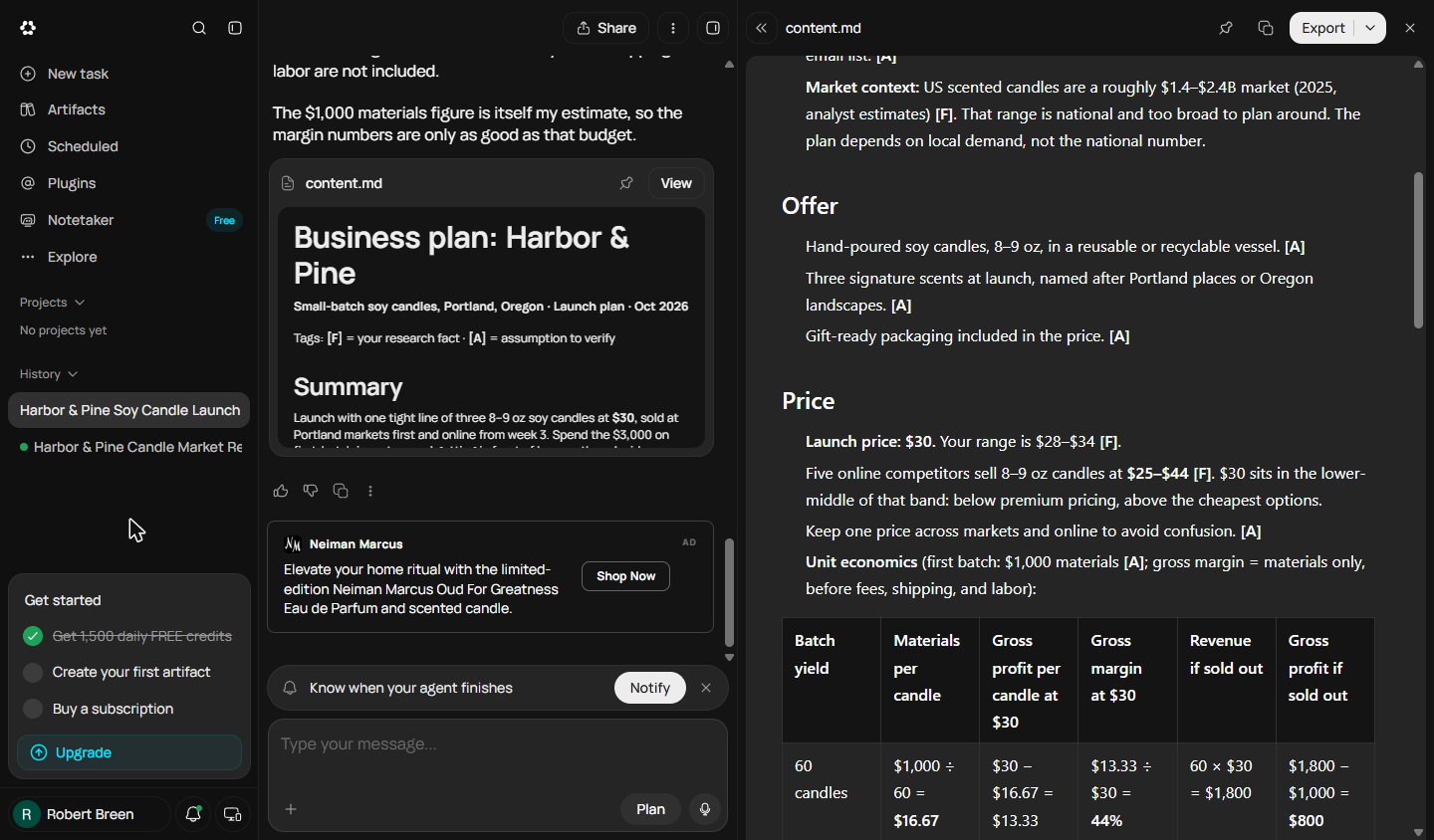
Now there's a table. Sixteen sixty-seven a candle. Forty-four percent margin. And it admits the thousand dollars is an estimate too.
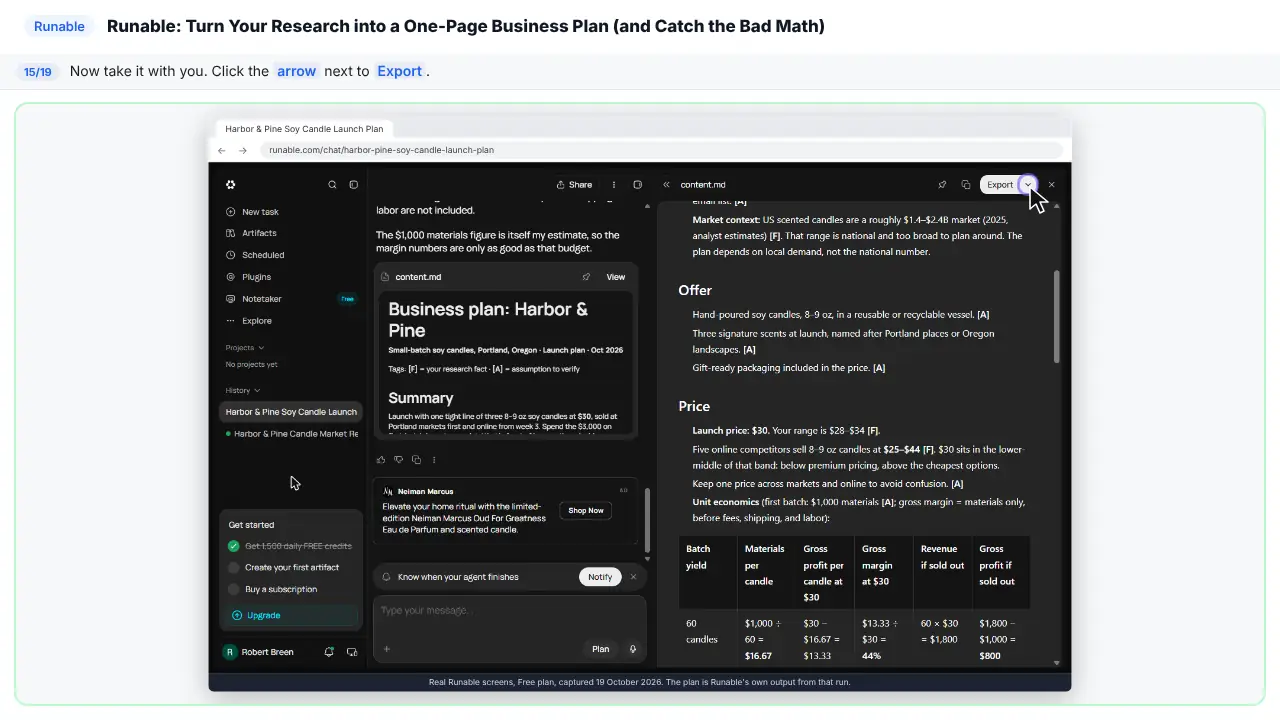
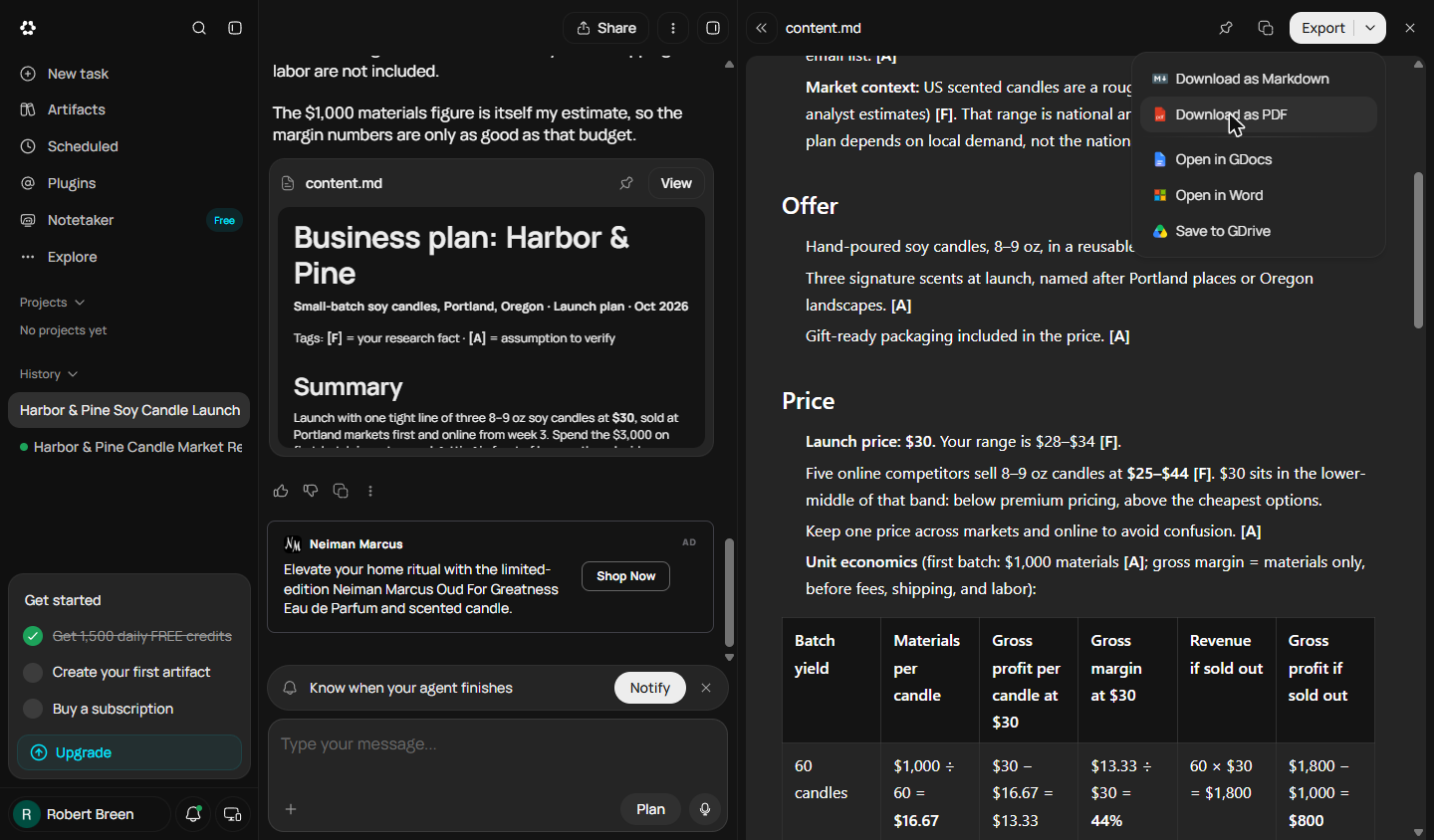
Step 15: Open the export options
Now take it with you.
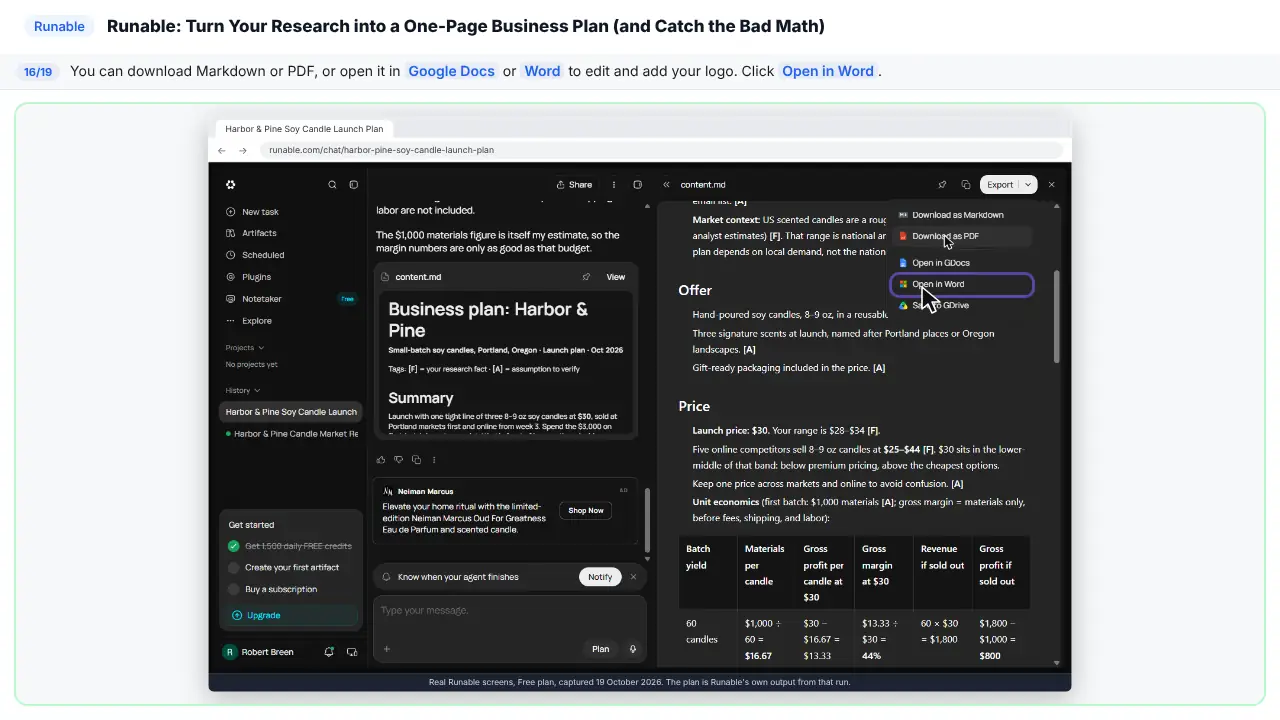
Step 16: Open it in Word
You can download it, or open it in Google Docs or Word to edit.
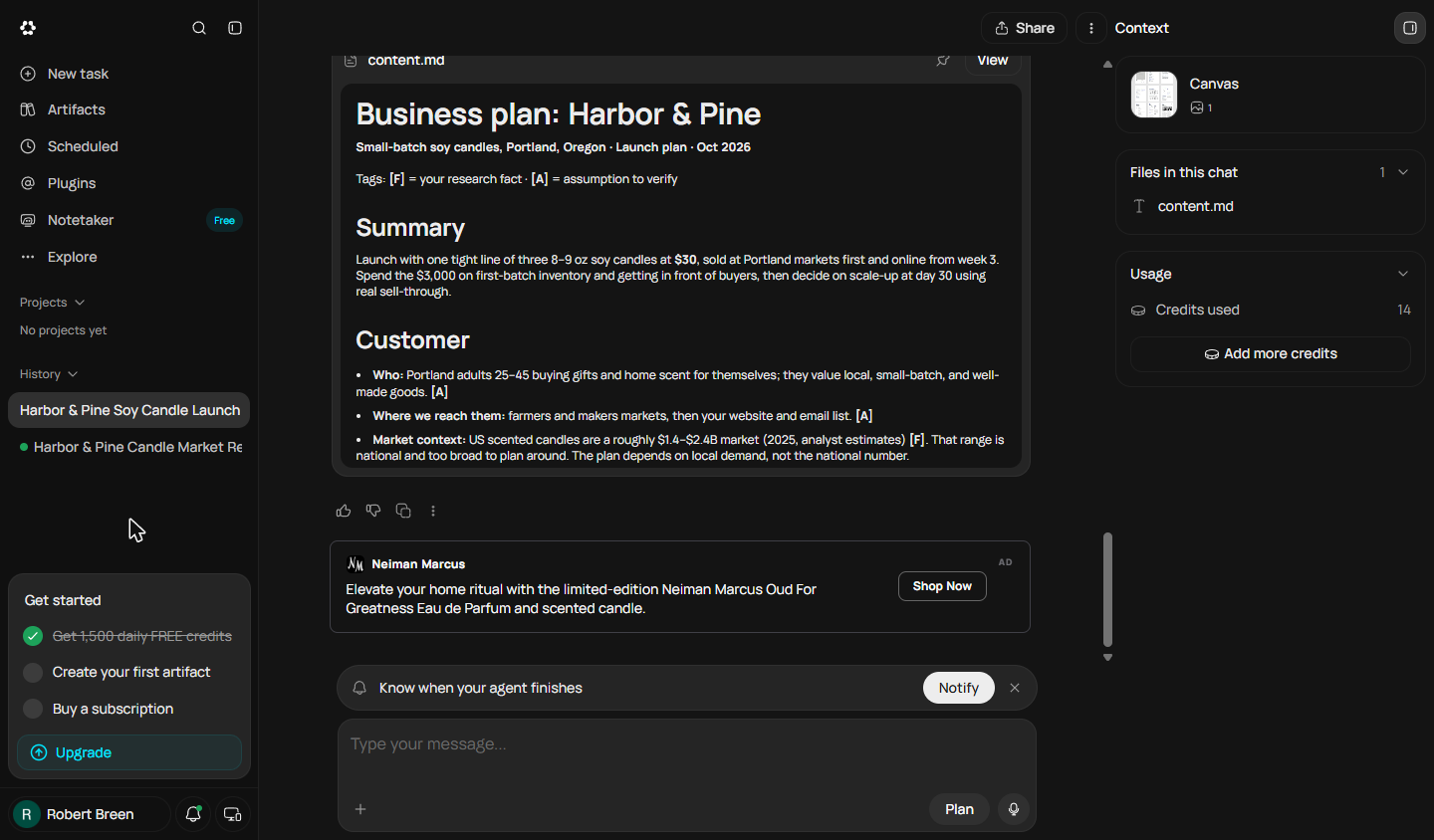
Step 17: See what it cost
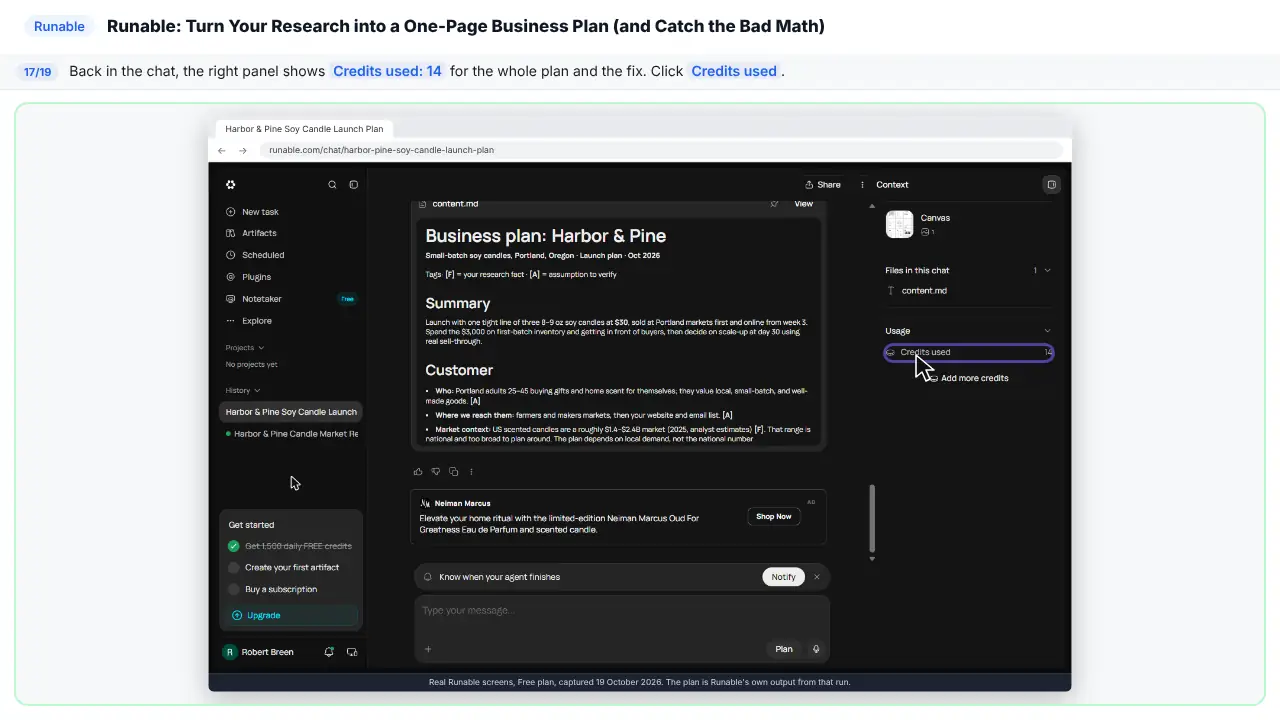
The whole plan, and the fix, used fourteen credits.
Part 5: What it saved, and what is next
Step 18: See what you have now
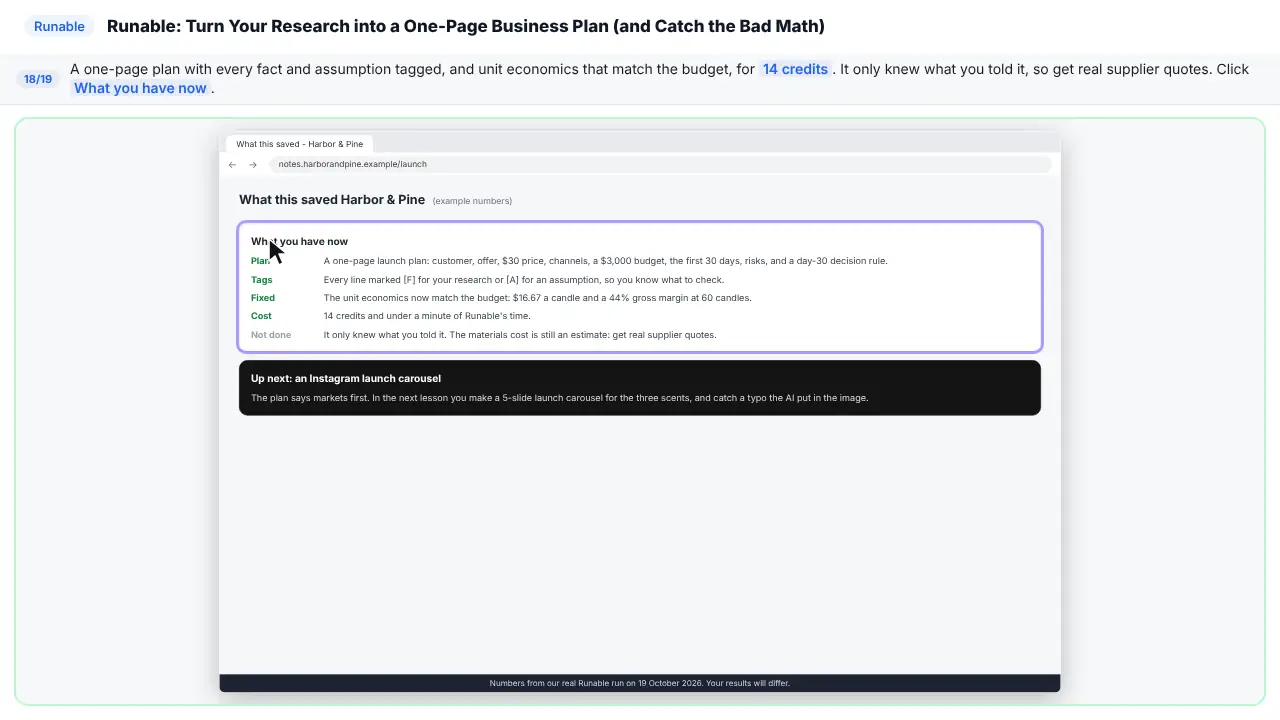
A one-page plan. Every assumption tagged. And the math adds up. All for fourteen credits.
Step 19: Up next
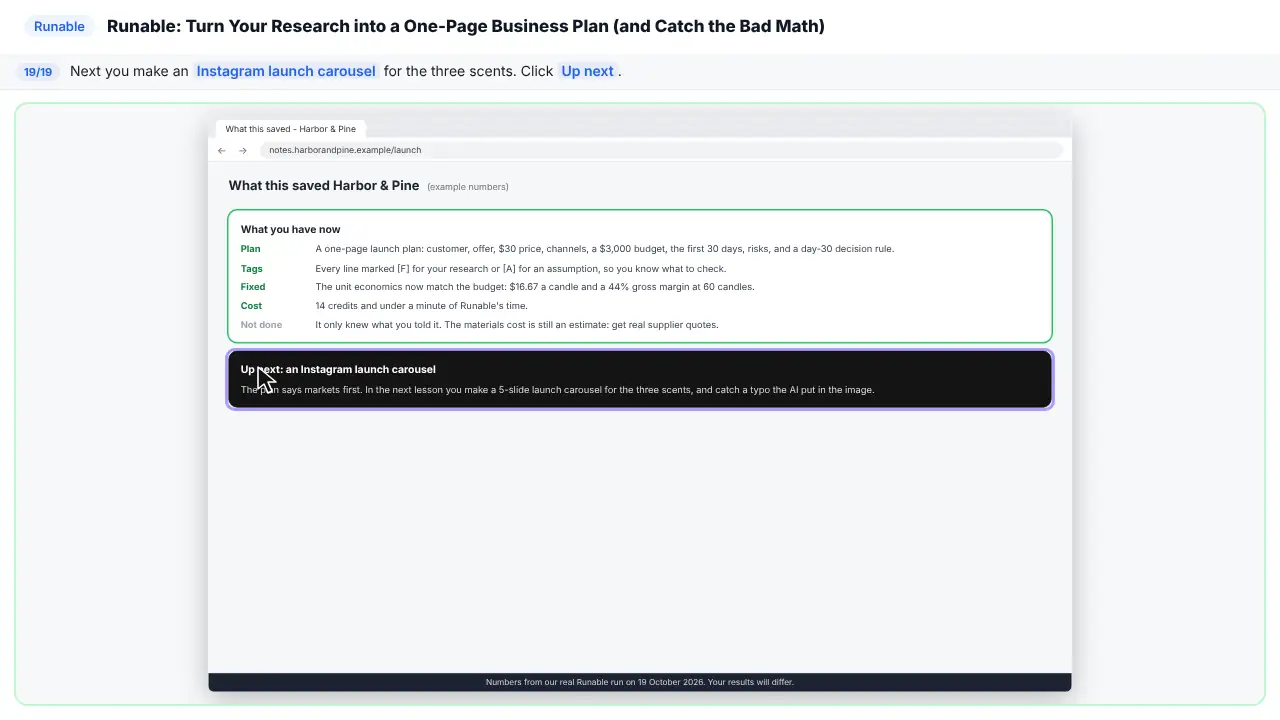
Next, you'll make an Instagram launch carousel.
Part of these free courses: Runable for Startups: Your One-Person Team, Jump Start: Runable
Now do it yourself, free
Reading the steps is a start. Doing them is how it sticks. The interactive lesson puts you in a practice copy of Runable: you do every step yourself, it checks your work, and “Do it for me” finishes any step you get stuck on. Nothing touches your real accounts.
Practice “Turn Your Research into a One-Page Business Plan using Runable” step by step
The business case: a plan with one wrong number is worse than none
A plan writer charges $500 to $1,500, or you lose a weekend to a template. And if the plan says you make 70% on every candle when you really make 44%, you price, order and borrow on the wrong number. These are example numbers; use your own.
What you do in the lesson
You pick Report, then Business Plan, then a template, and paste your research facts over the template's sample prompt about a tea brand. Runable wrote the plan in 48 seconds: three scents at $30, markets first and online from week 3, a $3,000 budget, the first 30 days, a risk table and a day-30 decision rule, with every line tagged [F] or [A].
Then you read it like a lender. The first version said about $9 of materials per candle. Its own budget put $1,000 into 60 to 80 candles, which is $12.50 to $16.67 each. You ask for the fix with the math, and Runable adds a unit economics table: $16.67 a candle and a 44% gross margin at $30, and notes that the $1,000 is itself an estimate.
Links
- Runable: the AI agent this course teaches. Its Free plan showed 1,500 credits a day when we tested it in October 2026.
- Runable pricing: current plans, credits and limits. Check them before you rely on the Free plan.
Try it yourself, free
Reading the steps is a start. Doing them is how it sticks. The interactive module walks you through every click in a practice copy of Runable, checks each step, and never touches your real accounts.
Start “Turn Your Research into a One-Page Business Plan using Runable”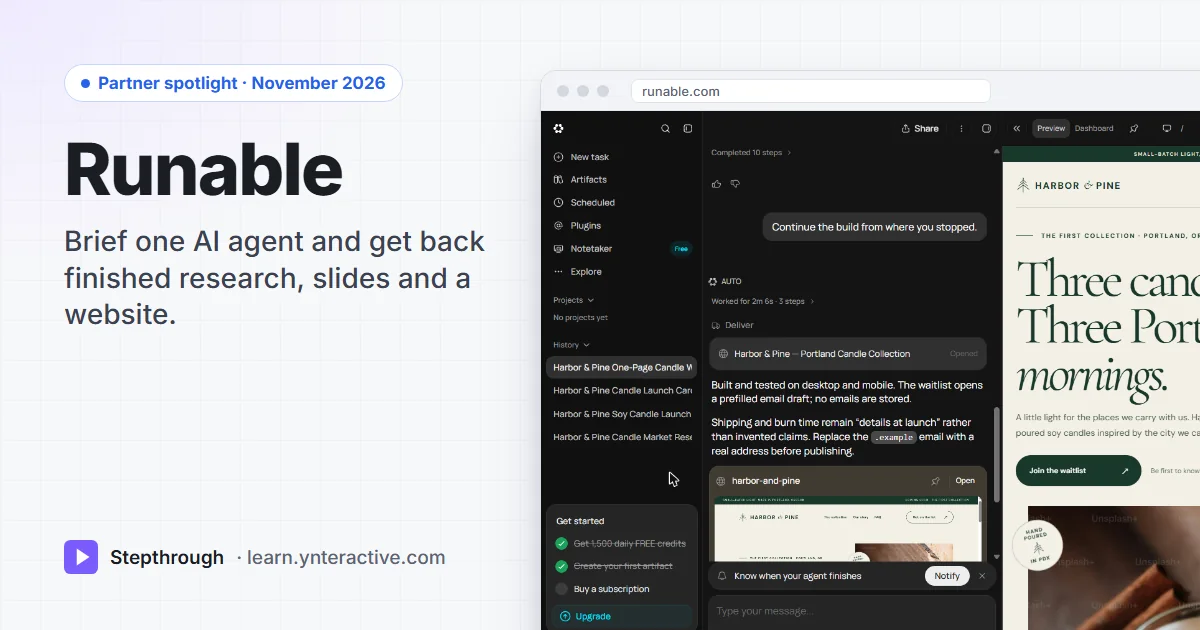
November 2026 spotlight
Runable
A general AI agent that turns one brief into finished research, a business plan, slides, carousels and a one-page website, like a one-person team for a small office.
Screenshots
Frequently asked questions
- Can Runable write a business plan?
- Yes. Runable's Report tool has a Business Plan starting prompt and templates. In our test it wrote a one-page launch plan in under a minute for 14 credits.
- Are the numbers in an AI business plan reliable?
- Treat them as a draft. Our first version had a cost per candle that did not match its own budget. Ask the AI to tag assumptions, divide the key numbers yourself, and ask it to show the math when they disagree.
- Can I edit the plan in Word or Google Docs?
- The Export menu offers Download as Markdown or PDF, Open in Google Docs, Open in Word and Save to Google Drive. We opened the menu but did not run the export.
More Runable tutorials
A business case for a small agency: price what a slow proposal costs, then use Runable, an AI agent, to turn a messy client email into a finished six-slide proposal…
Free · Live ~16 min Beginner
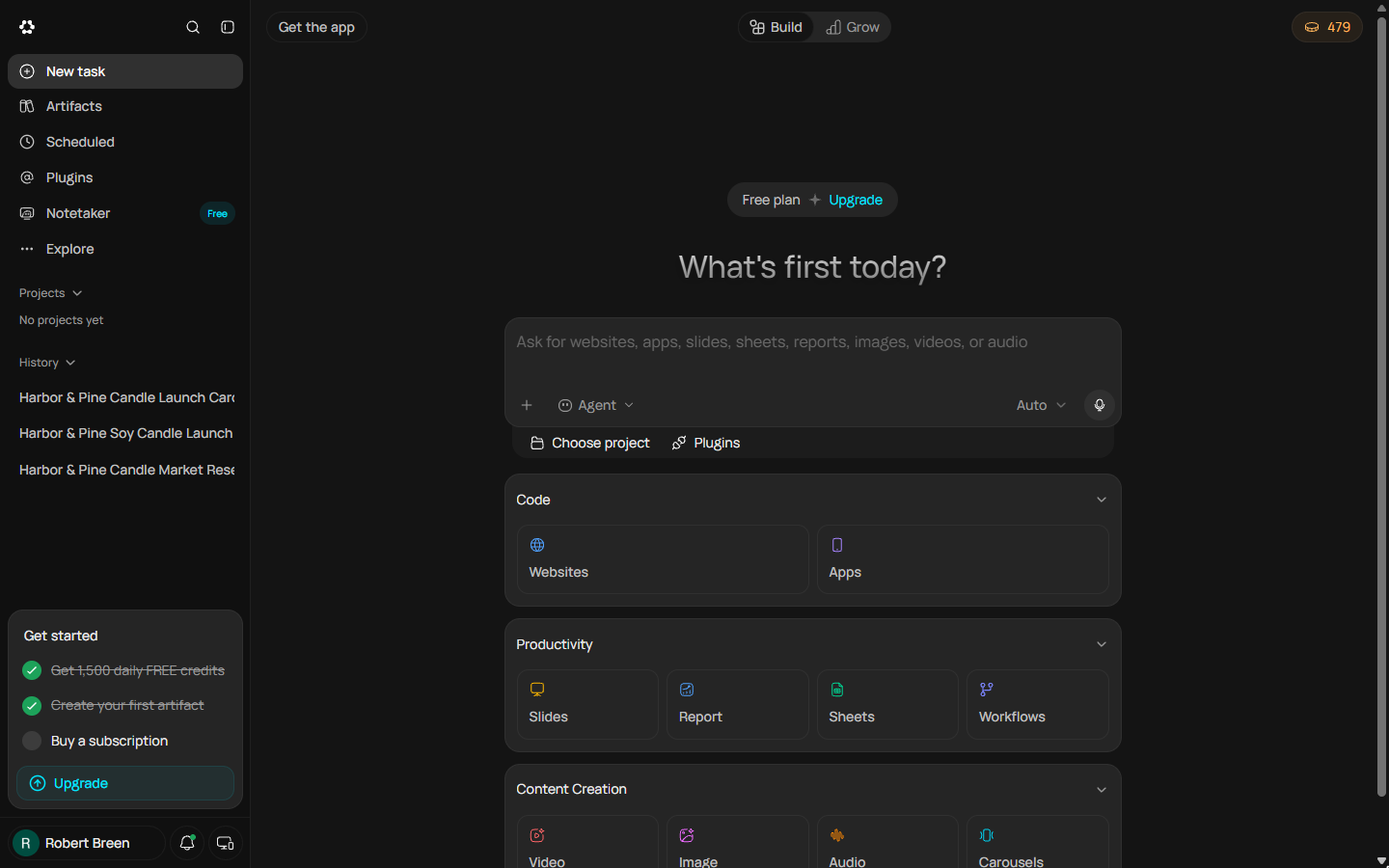 Brief a One-Page Website and Approve the Plan using Runable (and Budget Your Credits)
A business case for new founders: brief Runable's Websites tool for a one-page site, answer its two clarifying questions, approve the plan, run out of free credits…
Free · Live ~16 min Beginner
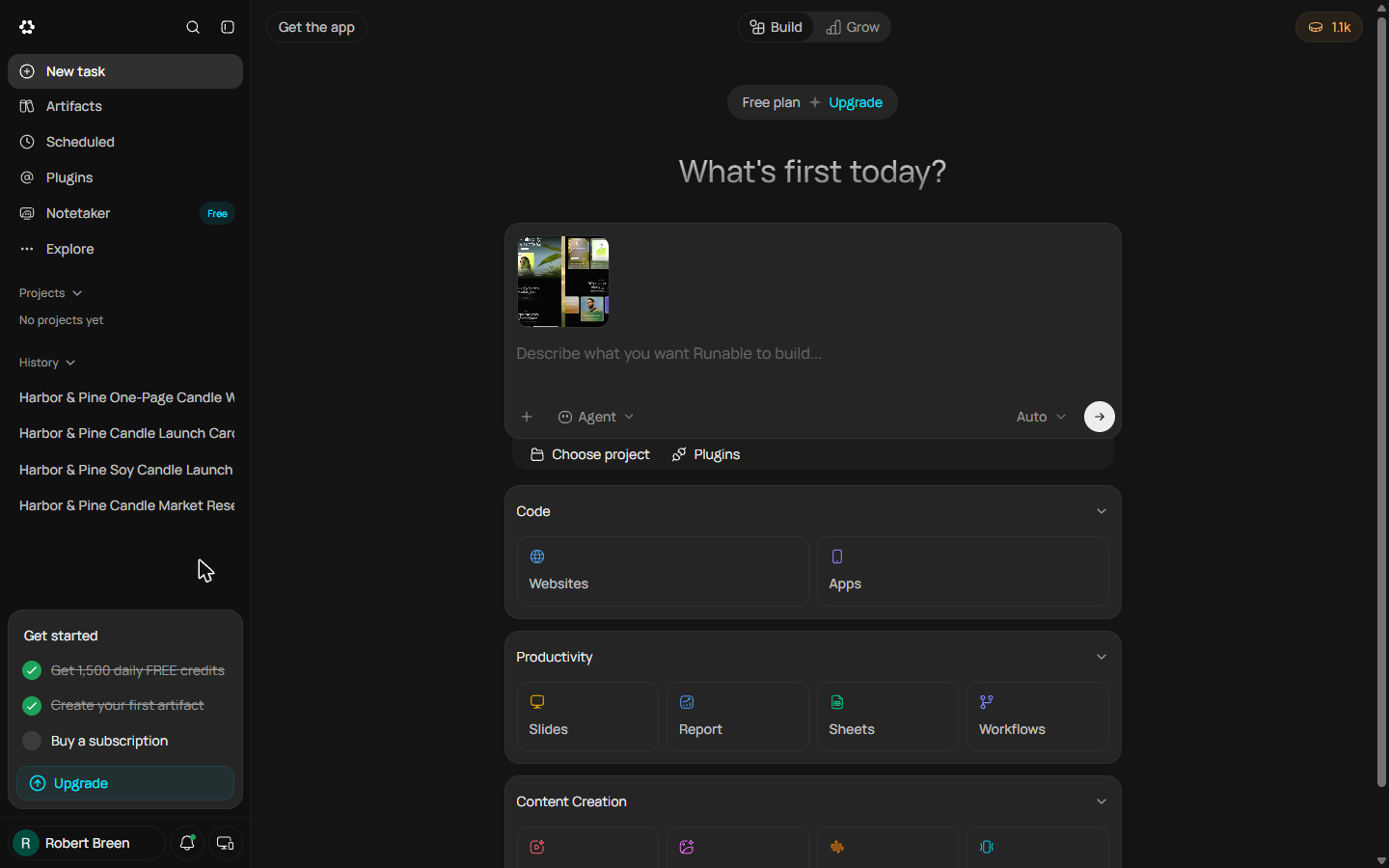 Turn Customer Questions into a Help Page and DM Replies using Runable (and Check What It Changed)
A business case for small shops: turn the questions customers keep asking into a help page and paste-ready DM replies with Runable, make it list what your facts don't…
Free · Live ~10 min Beginner
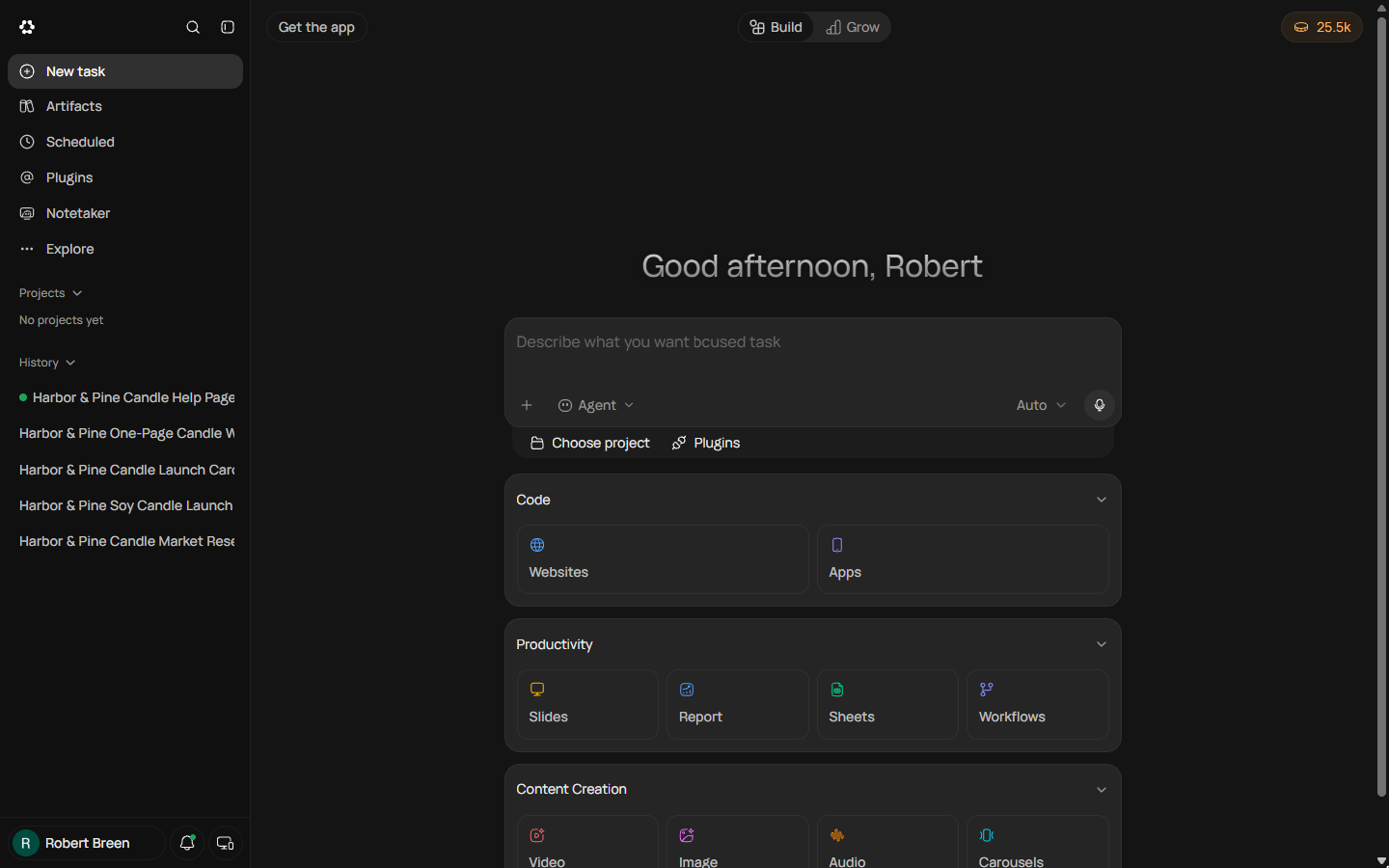 Replace the Clipboard Stock Count with an App using Runable (and Test It Before You Approve)
A business case for office managers: describe a phone-friendly stock-count app to Runable's App Builder, catch a plan that would keep the counts in each phone's…
Free · Live ~11 min Beginner
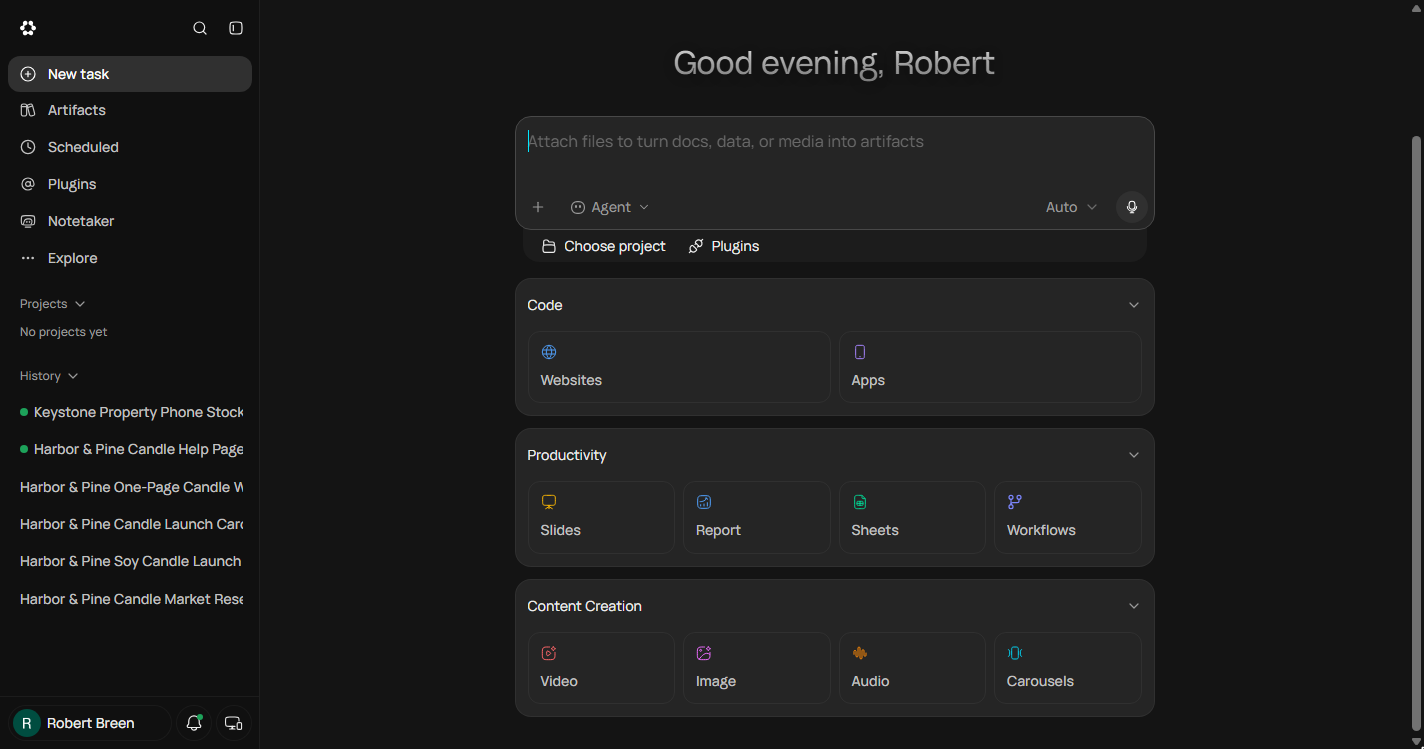 Build a Weighted Interview Scorecard with Runable (and Catch What the Averages Hide)
A business case for hiring managers: brief Runable's Sheets tool for a weighted interview scorecard with a summary and question bank, check the formulas and the notes…
Free · Live ~10 min Beginner
 Know How Many Sales Pay the Bills Before You Order Stock using Runable
A business case for founders: brief Runable's Sheets tool for a break-even and pricing workbook, check the unit economics by hand, catch a price table that answers the…
Free · Live ~11 min Beginner
From the blog
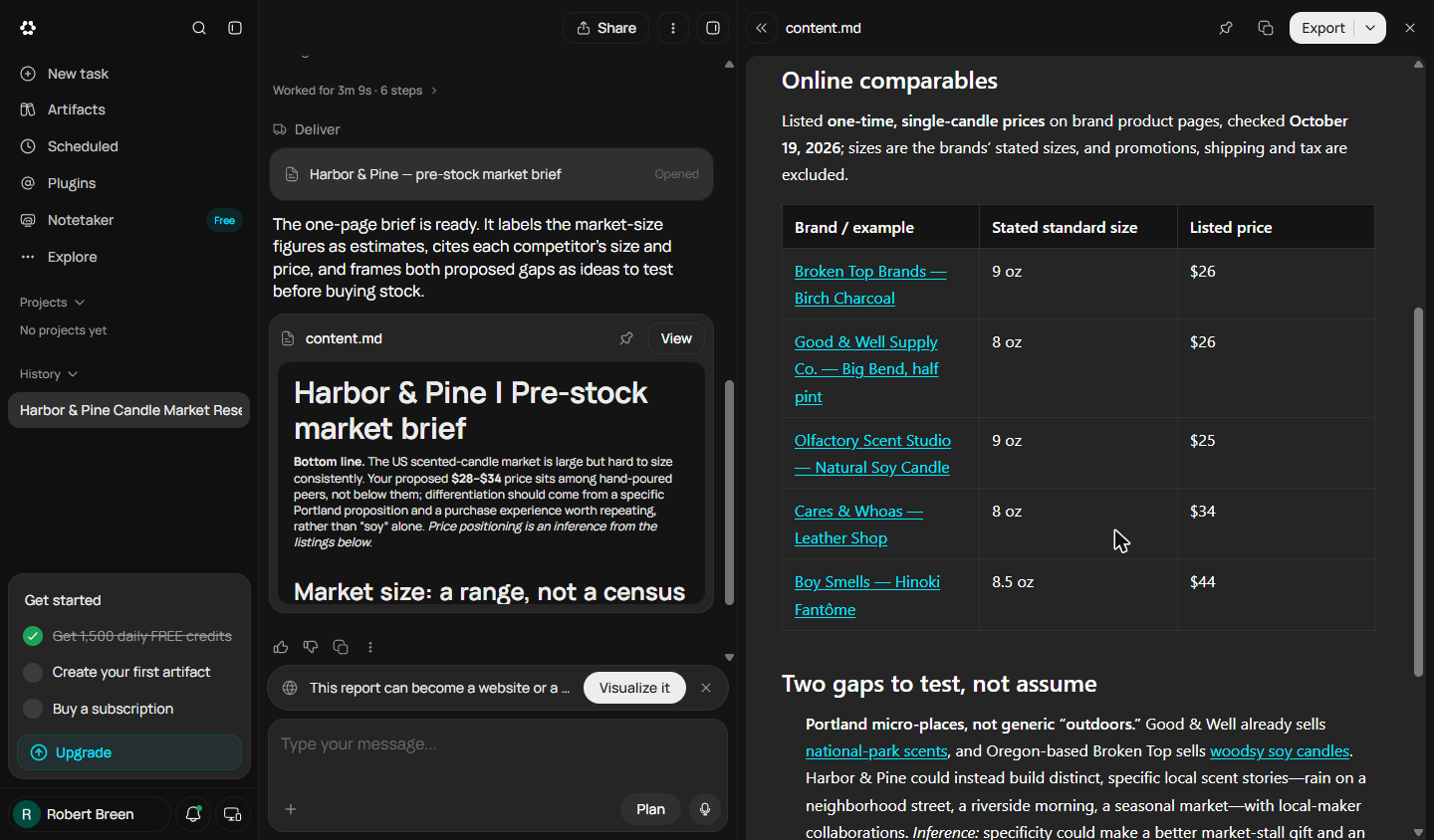 Runable Prompts and Templates: Free Harbor & Pine Files
Download the five files from the Runable course: the research brief, competitor check sheet, plan facts and prompt, the finished plan and carousel copy.
Oct 20, 2026 5 min read
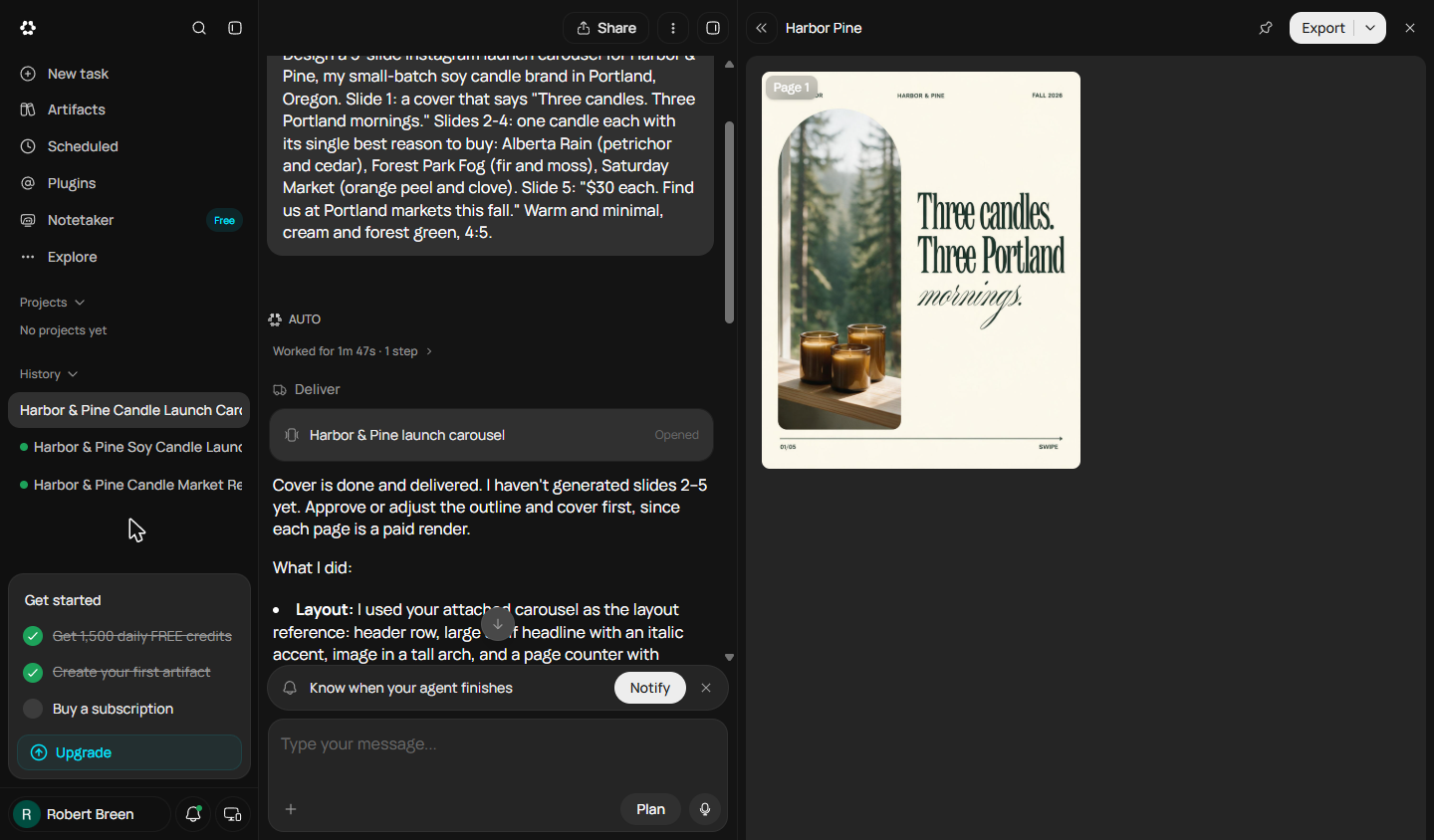 Runable Use Cases by Role: Founders, Consultants, Marketers
How founders, consultants, marketers, analysts and ops leads can use Runable's research briefs, one-page plans and carousels, with the checks each needs.
Oct 20, 2026 5 min read
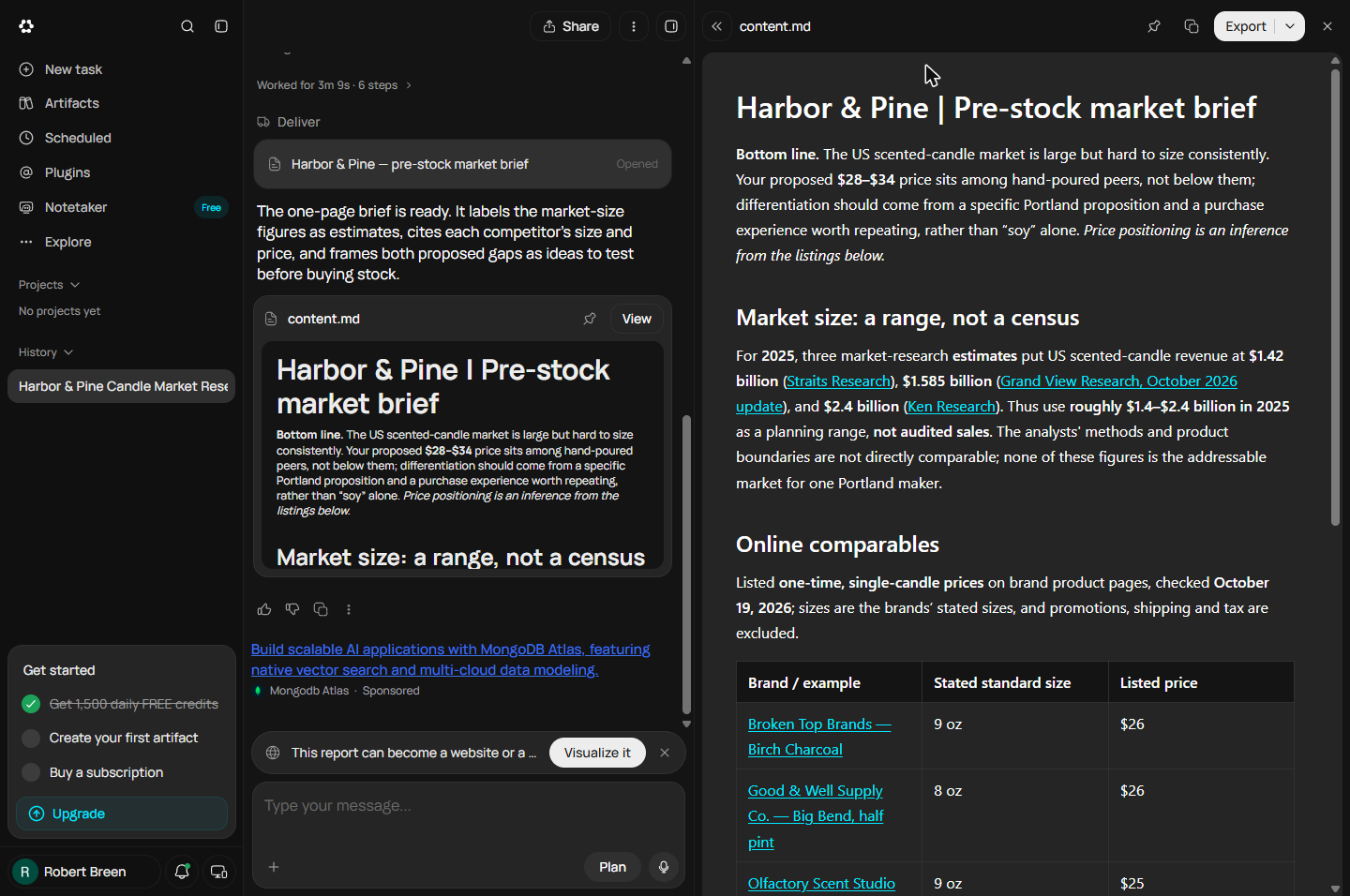 Runable FAQ: Credits, Research, Plans and Carousels
Answers about Runable from a real Free-plan run: what it is, how credits work, research briefs, business plans, carousels, exports and what to check.
Oct 20, 2026 4 min read
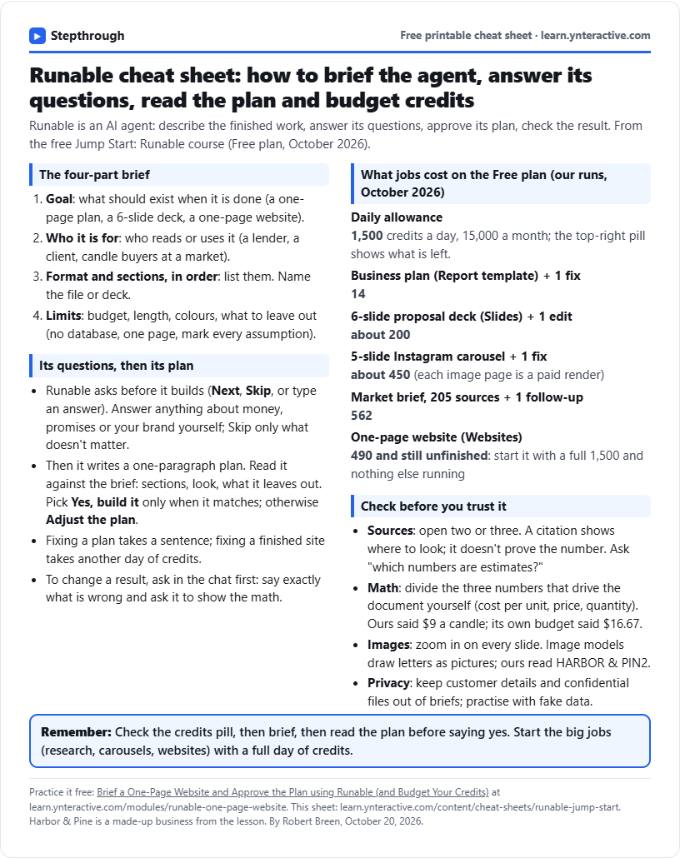
Free cheat sheet
Print it or save the PDF: the key steps and checks from this lesson on one page, free.
All free printable cheat sheets
Terms in this lesson
Plain-English definitions, each with an example from a free lesson.